In a recent impassioned speech, Cory Booker delivered a fiery defense of vulnerable social programs like Medicaid, Medicare, and Social Security. His delivery wasn’t just about policy, it was about people.
But how do we know what made the speech land — or where it risked losing its impact?
Here’s what Yoodli picked up on, and what we can learn from it.
What Booker Got Right
Yoodli: “Your passion shines through in your speech and establishes a strong emotional connection with your audience.”
From the opening lines to the closing appeals, the speaker used heartfelt personal anecdotes — like letters from struggling constituents — to humanize political issues. One standout line pulled straight from the Yoodli feedback:
“But if America hasn’t broken your heart, you don’t love her enough.”
It’s powerful. Vulnerable. And it communicates urgency without needing statistics.
Emotion drives action. Whether you’re a policymaker or a seller, if your audience feels something, they’re more likely to engage.
What Could Be Better
Despite the passion, Yoodli flagged a common pitfall: the speech felt repetitive and lacked concise phrasing in parts.
Yoodli: “Your speech often feels repetitive and lacks concise phrasing, reducing its impact.”
To address this, Yoodli recommended using the Rule of Three — a classic communication technique that clusters ideas into punchy, memorable triads. For instance, instead of long paragraphs, a line like this could be stronger:
“Reduced office locations, longer processing times, and denied benefits.”
Structure doesn’t limit emotion — it supports it. The most powerful speeches marry heart with clarity.
Why it Matters
Whether you’re in government, sales, or advocacy, public speaking is more than just what you say — it’s how you say it. Tools like Yoodli make that visible by giving leaders real-time, personalized coaching on:
Emotional tone
Word choice and filler usage
Clarity and pacing
Persuasive structure
In this case, Yoodli surfaced both the passion that made the speech compelling and the opportunities to tighten its delivery — so the message hits harder.
The Takeaway
The heart of democracy is communication. When we equip leaders with tools to speak with clarity and conviction, we don’t just improve speeches — we move people.
Whether you’re coaching a candidate or crafting a sales pitch: emotional intelligence plus AI feedback is a game-changer.
Ready for your own game-changing speedh? Check us out!
Note: This analysis reflects feedback from Yoodli’s AI and does not represent the views or political affiliations of the Yoodli team.
Cara E. Yar Khan takes us through her own journey to success as she weaves an inspiring story of courage and fear in her 3-minute TED talk. Weaving together years of personal experience, Khan shares how the balance between fear and courage enabled her to go on a Grand Canyon expedition despite her physical challenges.
Delve into the depths of Khan’s inspirational story to discover what true success looks like.
TED Talk “The Beautiful Balance between Courage and Fear” Speech Summary
Below are the summarized points from Khan’s speech. We used the free AI communication coach, Yoodli, to gain these valuable insights. You can check it out for yourself at http://www.yoodli.ai and view the speech here.
Person had a dream of working for the UN in some of the toughest countries
Courage is a balance between fear and bravery
Was diagnosed with hereditary inclusion body myopathy (HIBM), a progressive muscle wasting disease with no cure
Other people advised to limit ambitions and dreams
Ignored this advice and continued international career
Dreamed of an outdoor adventure and decided to cross Grand Canyon rim to rim, which involved four days on horseback and eight days rafting
Encountered unexpected obstacles, including a fall and a fear of heights
Maintained courage throughout, resulting in a successful expedition
Life is a balance between fear and courage and pushing through fears can lead to extraordinary experiences
TED Talk “The Beautiful Balance between Courage and Fear” Speech Text
Below is the text from Khan’sTED talk, “The Beautiful Balance between Courage and Fear.” We retrieved this transcript thanks to Yoodli’s AI platform.
When we’re young, we’re innocently brave, and we fearlessly dream about what our lives might be like. Maybe you wanted to be an astronaut or a rocket scientist. Maybe you dreamed of traveling to every continent. Since I was very young, I dreamed of working for the United Nations in some of the most difficult countries in the world. And thanks to a lot of courage that dream came true. But here’s the thing about courage: it doesn’t just appear whenever we need it. It’s the result of tough reflection and real work, involving the balance between fear and bravery. Without fear, we’ll do foolish things. And without courage, we’ll never step into the unknown. The balance of the two is where the magic lies, and it’s a balance we all deal with every day.
First, a word about my fancy wheels. I haven’t always used a wheelchair. I grew up like many of you, running, jumping and dancing. I love to dance. However, in my mid-twenties, I began to experience a series of inexplicable falls. And a few years later, I was diagnosed with a recessive genetic condition called hereditary inclusion body myopathy, or HIBM. It’s a progressive muscle wasting disease that affects all of my muscles from head to toe. HIBM is very rare. In the United States there are less than 200 people diagnosed. To date, there is no proved treatment or cure, and within 10 to 15 years of its onset, HIBM typically leads to quadriplegia, which is why I now use a wheelchair.
When I was first diagnosed, everything changed. It was frightening news because I had no experience with chronic illness or disabilities. And I had no idea how the disease might progress. But what was most disheartening was to listen to other people advise me to limit my ambitions and dreams, and to change my expectations of what to expect from life. “You should quit your international career.” “No one will marry you this way.” “You would be selfish to have children.” The fact that someone who wasn’t me was putting limitations on my dreams and ambitions was preposterous. And unacceptable.
So I ignored them. (Cheers and applause) I did get married. And I decided for myself not to have children. And I continued my career with the United Nations after my diagnosis, going to work for two years in Angola, a country recovering from 27 years of brutal civil war. However, it would be another five years until I officially declared my diagnosis to my employer. Because I was afraid that they would question my capacity to manage and I’d lose my job. I was working in countries where polio had been common, so when I overheard someone say that they thought I might have survived polio, I thought my secret was safe. No one asked why I was limping. So I didn’t say anything. It took me over a decade to internalize the severity of HIBM, even as basic tasks and functions became increasingly difficult. Yet, I continued to pursue my dream of working all over the world, and was even appointed as a disability focal point for UNICEF in Haiti, where I served for two years after the devastating 2010 earthquake.
And then my work brought me to the United States. And even as the disease progressed significantly and I needed leg braces and a walker to get around, I still longed for adventure. And this time, I started dreaming of a grand outdoor adventure. And what’s more grand than the Grand Canyon? Did you know that for every five million people who visit the Rim only one percent go down to the canyon’s base? I wanted to be a part of that one percent. The only thing is — (Applause) The only thing is that the Grand Canyon isn’t exactly accessible. I was going to need some assistance to get down the 5,000-foot descent of vertical loose terrain.
Now, when I face obstacles, fear doesn’t necessarily immediately set in because I assume that one way or another, I’ll figure it out. And in this case, my thought was, well, if I can’t walk down, I could learn to ride a horse. So that’s what I did. And with that fateful decision began a four-year commitment, tossing back and forth between fear and courage to undertake a 12-day expedition. Four days on horseback to cross Grand Canyon rim to rim, and eight days rafting 150 miles of the Colorado River, all with a film crew in tow. Spoiler alert — we made it. But not without showing me how my deepest fear can somehow manifest a mirror response of equal courage.
On April 13, 2018, sitting eight feet above the ground, riding a mustang horse named Sheriff, my first impression of Grand Canyon was one of shock and terror. Who knew I had a fear of heights. (Laughter) But there was no giving up now. I mustered up every ounce of courage inside me to not let my fear get the best of me. Embarking on the South Rim, all I could do to keep myself composed was to breathe deeply, stare up into the clouds and focus on my team’s voices.
But then, in the first hour, disaster struck. Unable to hold myself upright in the saddle, going down an oversized step, I flung forward and smacked my face on the back of the horse’s head. There was panic, my head hurt fiercely, but the path was too narrow for us to dismount. Only at the halfway point at 2,300 feet, at least another two hours down, could we stop and remove my helmet and see the egg-sized bump protruding from my forehead. For all of that planning and gear, how is it that we didn’t even have an ice pack? (Laughter) Luckily for all of us, the swelling came outwards, and would drain into my face as two fantastic black eyes which is an amazing way to look in a documentary film. (Laughter) (Applause and cheers)
This was not an easy, peaceful journey, and yet, that was exactly the point. Even though I was afraid to get back into the saddle, I got back in. The descent alone to the canyon floor took a total of 10 hours and that was just day one of four riding.
Next came the mighty rapids. The Colorado River in the Grand Canyon has some of the highest white water in the country. And just to be prepared in case we should capsize, we’d practice having me swim through a smaller rapid. And it’s safe to say it wasn’t glamorous. (Laughter) I took my breath in the wrong part of the wave, choked on river water and was unable to steer myself. Yes, it was scary, but it was also fantastic. Waterfalls, slick canyons and a couple billion years of bedrock that seemed to change color throughout the day.
The Grand Canyon is true wilderness and worthy of all of its accolades. (Applause) The expedition, all that planning and the trip itself, showed me a level of fear I had never experienced before. But more importantly, it showed me how boldly courageous I can be. My Grand Canyon journey was not easy. This was not a vision of an Amazonian woman effortlessly making her way through epic scenery. This was me crying, exhausted and beat up with two black eyes. It was scary, it was stressful, it was exhilarating.Now that the trip is over, it’s easy to be blasé about what we achieved. I know I want to raft the river again. This time, all 277 miles of it. (Applause) But I also know that I would never do the horseback-riding part again. (Laughter) It’s just too dangerous.
And that’s my real point. I’m not just here to show you my film footage. I’m here to remind us all that life is really just a lesson in finding the balance between fear and courage. And understanding what is and what isn’t a good idea. (Laughter) Life is already scary, so for our dreams to come true, we need to be brave. In facing my fears and finding the courage to push through them, I swear my life has been extraordinary. So live big and try to let your courage outweigh your fear. You never know where it might take you.Thank you. (Applause and cheers)
TED Talk “The Beautiful Balance between Courage and Fear” Speech Analysis
If you liked this breakdown of Khan’s “The Beautiful Balance between Courage and Fear” TED talk, you can create an account with Yoodli and upload/record your own speech. You’ll then receive feedback and tips for improvement right away.
Don’t hesitate to check out your own speech analytics and speaking patterns.
Cara E. Yar Khan’s Word Choice
Khan’s word choice was excellent overall. There were no significant areas of improvement here, from her filler word and weak word usage to repetition and non-inclusiveness.
Although everyone has room for improvement, Khan truly nailed it. At most, she could aim to decrease her number of weak words, which comes out to 17 total. Still, it’s only natural to have fewer than 4% weak words.
Cara E. Yar Khan’s word choice analytics were certainly impressive.
Cara E. Yar Khan’s Delivery
The delivery of Khan’s speech was just as phenomenal — There really weren’t any big areas of concern here, either.
Her pacing was relaxed and conversational at 154 words per minute, and she sounded calm throughout her speech. Khan also included a handful of strategic pauses to allow the audience members to absorb the information better. Her facial expressions and natural body language also stood out as speech successes.
Although, Yoodli did identify a few areas for improvement, in this case, we have to take them with a grain of salt. The areas in question were centering and eye contact. However, because the recording of Khan speaking used multiple camera angles, it would be impossible for her to be perfectly front-and-center. With regard to eye contact, even though she was making contact with audience members, it wasn’t picked up due to the various camera angles.
The Bottom Line
Explore the many uses of Yoodli today — free of charge — to find out how you match up against speakers like Khan. Compare your analytics with your friends or even other famous speakers and let Yoodli’s recommendations for improvement guide you.
In Pat Mitchell’s inspiring 3-minute TED Talk, “Dangerous Times Call for Dangerous Women,” she examines what it means to be a powerful woman in dangerous times and how we can use our collective power to create positive change.
TED Talk “Dangerous Times Call for Dangerous Women” Speech Summary
Using Yoodli, a free AI speech coach platform, we analyzed Mitchell’s speech to get in-depth insights. You can get started at http://www.yoodli.ai and view the speech here.
Declaring, “I am a dangerous woman” still feels a bit dangerous, but it feels right.
We are living in dangerous times and such times call for more dangerous people.
Becoming dangerous means speaking the truth when silence is a lot safer, speaking up in rooms for those who aren’t present, and challenging the cultural construct that encourages us to compete, compare, and criticize.
Needs opportunities to claim power, use power, and share power.
Bella Abzug’s idea: “In the 21st century, women will change the nature of power rather than power changing the nature of women.”
Have observed women climate leaders working behinds the scenes, out of the public spotlight, to keep global climate negotiations moving forward
It’s time to play the women’s card, race card, and all other cards to advocate and agitate for fairer and truer and more equal representation in every room and at every table
It’s time to change the nature of power by dismantling some of the barriers that remain for those who follow.
Leverage the power of media and technology to elevate each other’s stories and ideas; practice civility; and seek the truth.
Allocate more of our philanthropic dollars, our campaign donations, and our investment funds to increase economic and political equity
Hold the torch higher than ever and invite others to join in its dangerous light
TED Talk “Dangerous Times Call for Dangerous Women” Speech Text
Below is the text from Mitchell’s TED talk, “Dangerous Times Call for Dangerous Women,” retrieved from Yoodli’s platform using AI:
Recently, I’ve been declaring to anyone who would listen that I am a dangerous woman. (Applause) Now, declaring that boldly like this still feels a bit dangerous, but it also feels right. At this time in my life, about to be 77, I have — (Applause) I love when you’re applauded for your age — (Laughter) but I’ll take it. (Applause) About to be 77, I realize that I have nothing left to prove, less to lose, and I’m more impatient about everything. The true, slow pace towards equality, the rise in sexism, racism, violence against women and girls … And I’m angry, too, at the climate deniers who are stealing the future from our children and grandchildren. Friends, we are living in dangerous times. And such times call for all of us to be more dangerous.
Now, what do I mean by this? I don’t mean being feared. It’s not that kind of dangerous. But I do mean being more fearless. I mean speaking the truth when silence is a lot safer. I mean speaking up in rooms for those who aren’t present, especially those rooms where decisions are made about our lives and our bodies. We need to be in those rooms, showing up for one another, challenging the cultural construct that encourages us, especially women and girls, to compete, compare, criticize. We have to end this. And speaking out against the policies and the politics that divide us and diminish our collective power as a global community of women, and the men and the allies who stand with us.
Becoming dangerous also means embracing whatever risks are necessary to create a world where women and girls are safe in their homes and at work, where all voices are represented and respected, all votes counted, the planet protected. And this is all possible. Because we’re ready for this. We’re better prepared than any generation ever before us, better resourced, better connected. In many parts of the world, we’re living longer than ever. Women over 65 are among the fastest-growing populations on earth, with the potential for becoming the most powerful, too.
Now — (Applause) What a change this represents. Postmenopausal women like me, not that long ago, were considered useless or crazy. We were valued for caregiving and grandmothering — and I really love that part. But we were pushed aside and expected to retire to our rocking chairs. Women on the dangerous side of 60 are not retiring. We are rewiring —(Applause) taking all that we know and have done — and that is a lot — to redefine what age looks like, can do, can accomplish. But becoming dangerous isn’t about becoming a certain age, because at each end of the age spectrum, brave women and girls are stepping up, taking the risk to create change.
I became a risk-taker early in my life’s journey. I had to, or have my life defined by the limitations for a girl growing up in the rural South, with no money, no connections, no influence. But what wasn’t limited was my curiosity about the world beyond my small town, beyond the small minds of a still-segregated South, a world that I glimpsed in the newsreels at the one movie theater in town, and a world that got a lot closer to me when I met Miss Shirley Rountree, my eighth-grade English teacher. From the minute she walked into the classroom, her high heels clicking, she was a woman in charge, with perfect hair, signature red lips, colorfully coordinated, head to toe. I wanted to be her. Gratefully, she became my first mentor and helped me become me. With her support, I got a scholarship to college — the first in my family — and landed at a big state university, right in the middle of two great social justice movements: civil rights for African Americans and equal rights for women. I joined both with enthusiasm, only to discover that my newfound activism and my fermenting feminism would often be in direct conflict with my deeply embedded need to please and be popular.
In my first job as a college teacher, I broke the rules, and I encouraged students to join me in the protest marches. And when I found out that my male colleague with the same experience and education was being paid more than me, I mounted a personal protest. When my raise was denied, with the excuse that he had a family to support, so did I as a single mom. But I dropped my protest to keep my job.
Today, millions of women are making this compromise, staying in their jobs without equal pay for equal work. And as one of the first women on television in the ’70s, I was warned that focusing on women’s stories would limit my career opportunities, and maybe it did. But I got to produce and host breakthrough programming for women, while at the same time, remaining silent about sexual harassment and listening to consultants who were hired to advise me about my appearance. “Become a blonde.” I did. “Lower your voice.” I tried. “Lower your necklines.” I didn’t. (Laughter) But I did wear those ugly anchor suits with those scarves that look something like men’s ties. And later, in the power positions in media, often as the first or only woman, aware of being judged through that gender lens, I struggled from time to time to find the right balance between being a leader for women and not being entirely defined as a woman leader.
But today, I’m proud to be known as a woman leader. (Applause) As an activist, advocate, feminist and as a newly declared dangerous woman, I’m caring less what others say and saying more clearly what I think and feel. And let me be clear: I acknowledge my privilege in being able to do that, to speak my truth. And to stand here today with this opportunity to talk to you about women and power — note I did not say “empowered.” I don’t think we’re waiting to be empowered. I think we have power. (Applause) What we need are more opportunities to claim it, to use it, to share it.
And yes, I know — there are women with power who don’t use it well or wisely and who don’t share it. I’ve heard, as I’m sure you have, those stories that begin with, “The worst boss I ever had was a woman …”And we could all name women leaders who have not made us proud.
But we can change all of that with a simple but brilliant idea that I first heard from a risk-taking, dangerous congresswoman from New York named Bella Abzug. Bella said, “In the 21st century, women will change the nature of power rather than power changing the nature of women.”From the moment I heard that —(Applause) I thought, “This is our call to action. This is our biggest opportunity.”And as a journalist and an activist, I’ve seen this idea in action, documenting the stories of women on both sides in long-term conflicts, coming together and defying the official power to form alliances and find their own ways to ending violence in their communities. And as an activist, I’ve traveled to places where it’s dangerous to be born a woman, like eastern Congo, where a war is being waged on the bodies of women. There, at a healing and leadership center called City of Joy, brave Congolese women are transforming pain into power by training survivors of sexual assault to return to their villages as leaders. And at recent climate summits, I’ve observed women climate leaders working behinds the scenes, out of the public spotlight, making sure that the negotiations toward global climate agreement continue to move forward.
So as we move forward in our lives and work and we have more power and influence, let’s change the nature of power by dismantling some of the barriers that remain for those who follow by advocating and agitating for fairer and truer and more equal representation in every room and at every table. Now, be warned: If you advocate for a woman for an open position or promotion, you could be challenged with, “You’re playing the women’s card” or “the race card” if advocating for a woman of color. I’ve had this experience, as I’m sure you have. “Are you running an affirmative action program here at PBS?” asked one of my board members when, as a new president, I announced my first hires as five qualified women. Now, my affirmative action had been to ask that the search firm bring me a candidate list that included the names of women and people of color who just happened to be, in my judgment, the best candidates for the position as well.
I say, dangerous women and our allies: it’s time to play the women’s card, play the race card, play all our cards. (Applause) Not to win the power game, but to lead to better outcomes for everyone. And it’s time, too, to discard that scarcity theory, the one that says, there’s only room for one of us at the top, so protect your turf, don’t make friends or allies. Changing the nature of power transforms “protect your turf”into “share your turf,” it encourages coalitions, it builds alliances, it strengthens and sustains friendships. My women friends are my source of renewable energy. (Applause) So are my mentors, my champions, my supporters, my sponsors, and all of the ways that we can and do show up for each other. We can become our sources of renewable power for each other. And along the way, we need to take better care of ourselves, and here, I am not the best role model. I don’t meditate. I don’t exercise regularly. But I do live aerobically. (Laughter) (Applause) Because I believe we can’t be dangerous from the sidelines, and there’s just too much to be done.
So let’s use all our power. How about the power of money? Let’s allocate more of our philanthropic dollars, our campaign donations, our investment funds, to increase economic and political equity. And let’s leverage the power of media and technology that we have in our hands, quite literally, to elevate each other’s stories and ideas; to practice civility; to seek the truth, which is diminishing and is threatening free and open societies. Yes, we have all that we need to move our communities forward. And the best thing we have, and what we must remember, is to be there for each other. We will move forward together, willing now to take more risk, to be more fearless, to speak up, speak out and show up for one another.
George Bernard Shaw once wrote that he believed in his opinion that his life belonged to the community, that the harder he worked, the more he lived and that he wanted to be thoroughly used up when he died. He went on to write, “Life is no brief candle to me but a splendid torch that I have got hold of for a moment before passing to future generations.” I, too, do not view my life as a brief candle, although I am burning it at both ends. (Laughter) And I do want it, and me, to be thoroughly used up when I die. But at this point in my life’s journey, I am not passing my torch. I am holding it higher than ever, boldly, brilliantly, inviting you to join me in its dangerous light. Thank you.(Applause)
TED Talk “Dangerous Times Call for Dangerous Women” Speech Analysis
If you liked what you read in this summary, text, and analysis of Mitchell’s “Dangerous times call for dangerous women” TED talk, why not sign up for a free Yoodli account? You can upload or record a speech of any length and subject and get immediate feedback and tips to make it better.
Getting instant speech analytics is easy. Just record or upload a video of yourself practicing a speech (regardless of topic and length) and you’ll receive immediate feedback and tips on how to make it even better.
Pat Mitchell’s Word Choice
With regard to word choice, Mitchell excelled. nailed it in terms of word choice. She didn’t use any filler words during her entire speech, which is saying something. Only 1% of her speech featured weak words — words that are close to fillers, such as “quite,” “just,” and “I mean.” .
However, the one thingYoodli did highlighted as a potential improvement was non-inclusive language. Mitchell only used one instance of what can be considered non-inclusive language — in this case, “crazy,” since it can be labelled as abelist and sanist — but this type of language is easy to change and replace.
In fact, Yoodli suggests changing it from “crazy” to “confusing,” to remove the non-inclusive term and replace it with another option.
Pat Mitchell’s word choice was fantastic overall.
Pat Mitchell’s Delivery
Mitchell’s body language is something that stands out as a win — she was often smiling and used some natural hand gestures as well. She also used some purposeful pauses to allow the audience some time to digest her message.
However, Yoodli did highlight a few areas of improvement. For example, the AI speech coach was able to detect that Mitchell’s speaking pace was a bit slower, at 117 words per minute. To improve the pacing, Yoodli suggested bringing that 117 to 120 words per minute — a small but impactful change.
Mitchell’s centering and eye contact were also deemed areas for improvement. However, we can take this with a grain of salt, considering she was speaking to a large audience and walking around the stage.
Pat Mitchell’s delivery was also great, although she could alter her pace to be a bit faster.
The Bottom Line
Just because you feel you don’t have an inspirational speech to share like Mitchell’s doesn’t mean your speech isn’t worth analyzing. Sign up with Yoodli today to experience for yourself the wonders of an AI-powered speech coach.
The power of AI has become more apparent within the past few years. In the Ted Talk: “How AI Could Empower Any Business”, Andrew Ng discusses the powerful implications of artificial intelligence.
Ted Talk: “How AI Could Empower Any Business” Speech Summary
We ran Ng’s Ted Talk through Yoodli, the AI-powered speech coaching platform. You can upload or record any speech and receive a generated summary similar to Ng’s speech, which has been included below. You can get started at https://yoodli.ai and view the full results for “How AI Could Empower Any Business” here.
Widespread literacy enables a much richer society than not everyone having to read and write
AI is mainly concentrated in big tech companies, due to the high cost of building an AI system and the potential for a large payoff from having hundreds of millions of users
AI may not always need massive data sets, as seen with a small pizza store
Half a million independent restaurants in the US serve tens of millions of customers, but no one-size-fits-all AI will work for them
AI development platforms shift the focus from code to data and let more people participate
These platforms can empower an inspector to build an AI system to detect fabric defects, a baker to check the quality of cakes, a farmer to check the quality of vegetables, and a furniture maker to check the quality of wood
Democratizing access to AI will ensure the wealth created by it is spread more evenly across society
Ted Talk: “How AI Could Empower Any Business” Speech Text
In addition to providing a speech summary, Yoodli also generates the text transcript of any speech.
When I think about the rise of ai, I’m reminded by the rise of literacy. A few hundred years ago, many people in society thought that maybe not everyone needed to be able to read and write. Back then many people were attending Fuse or herding sheeps, so maybe there was less need for written communication. And all that was needed was for the high priests and priestesses and monks to be able to read the Holy Book and the rest of us could just go to the temple or church or the holy building and sit and listen to the high priests and priestesses read to us. Fortunately, we’re since figured out that we can build a much richer society if lots of people can read and write today, AI is in the hands of the high priests and processes. These are the highly skilled AI engineers, many of whom work in the big tech companies, and most people have access only to the AI that they build for them.
I think that we can build a much rich society if we can enable everyone to help to write the future. But why is AI largely concentrated in the big tech companies? Because many of these AI projects have been expensive to build, they may require dozens of highly skill engineers and it may cost millions or tens of millions of dollars to build an AI system. And the large tech companies, particularly the ones with hundreds of millions or even billions of users, have been better than anyone else at making these investments pay off because for them, a one size fits all AI system such as one that improves web search or that recommends better products for online shopping can be applied to this very large number of users to generate a massive amount of revenue. But this recipe for AI does not work once you go outside the tech and internet sectors to other places where for the most part, there are hardly any projects that apply to a hundred million people or that generates comparable economics. Let me illustrate an example.
Many weekends I drive a few minutes from a house to a local pizza store to buy a slice of Hawaiian pizza from the gentleman that owns his pizza store, um, and his pizza sprayed. But he always has a lot of coat pizza sitting around and every weekend some different flavor of pizza is other star. But when I watch him operate his store, I get excited because by selling pizza, he is generating data and this is data that he can take advantage of if he had access to ai. AI systems are good at smarting patterns when given access to the right data and perhaps an AI system could spot if Mediterranean Pizzas sell really well on a Friday night, maybe could suggest to him to make more of it on a Friday afternoon. Now you might say to me, Hey Andrew, this is a small pizza store. What’s the big deal? And I say to the gentleman that owns this pizza store, something that could help him improve his revenues by a few thousand dollars a year.
That will be a huge deal to him. I know that there is a lot of hype about AI’s need for massive data sets and having more data does help. But contrary to the hype AI can often work just fine even on modest amounts of data such as the data generated by a single pizza store. So the real problem is not that there isn’t enough data from the pizza store, the real problem is that the small pizza store could never serve enough customers to justify the cost of hiring an AI team. I know that in the United States there are about half a million independent restaurants and collectively these restaurants do serve tens of millions of customers.
But every restaurant is different with a different menu, different customers, different ways of recording sales that no one size fits all. AI will work for all of them. What would it be like if we could enable small businesses and especially local businesses to use ai? Let’s take a look at what it might look like at a complete that makes and sells t-shirts. I would love if an accountant working for the t-shirt company can use AI for demand forecasting. Say, figure out what funny memes the print on t-shirts that would drive sales by looking at what’s trending on social media or for product placement.
Why can’t a front to store manager take pictures of what the store looks like and shorten AI and have an AI recommend where to place products to improve sales supply chain? Can an AI recommend to buyer whether or not they should pay $20 per yard for a piece of fabric now or if they should keep looking because they might be able to find it cheaper elsewhere or quality control? A quality inspector should be able to use AI to automatically scan pictures of the fabric being used to make t-shirts to check if there are any tears or discolorations in the calf. Today, large tech companies routinely use AI to solve problems like these and to great effect. But a typical t-shirt company or a typical auto mechanic or retailer or school or local farm will be using AI for exactly zero of these applications. Today, every t-shirt maker is sufficiently different from every other t-shirt maker that there is no one size vial AI that will work for all of them. And in fact, once you go outside the internet and tech sectors in other industries, even large companies such as the pharmaceutical companies, the car makers, the hospitals also struggle with this.
This is the long tail problem of ai. If you were to take all current and potential AI projects and sort them in decreasing order of value and plot them, you get drafted, looks like this. Maybe the single most valuable AI system is something that decides what ads to show people on the internet. Maybe the second most valuable is a web search engine. Maybe the third most valuable is a online shopping product recommendation system. But when you go to the right of this curve, you then get projects like t-shirt product placements or t-shirt demand forecasting or pizzeria demand forecasting.
And each of these is a unique project that needs to be custom built. Even T-shirt demand forecasting if it depends on trending memes on the on social media is a very different project than pizzeria. Um, demand forecasting if that depends on the sales data. So today there are millions of projects sitting on the tail of this distribution that no one is working on, but whose aggregate value is massive. So how can we enable small businesses and individuals to build AI systems that matter to them for most of the last few decades? If you want to build an AI system, this is what you have to do. You have to write pages and pages of code.
And while I would love for everyone to learn to code and in fact online education and also offline education are helping more people than ever learn to code. Unfortunately, not everyone has the time to do this, but there is an emerging new way to build AI systems that will let more people participate just as pen and paper, which are a vastly superior technology to stones, tablet and chisel where instrumental to widespread literacy, there are emerging new AI development platforms that shift the focus from asking you to write lots of code to asking you to focus on providing data. And this turns out to be much easier for a lot of people to do today. There there are multiple companies working on platforms like these.
Let me illustrate a few of the concepts using one that my team has been building. Take the example of an inspector wanting AI to help detect defects in fabric. An inspector can take pictures of the fabric and upload it to a platform like this and they can go in to show the AI what tears in the fabric looks like by drawing rectangles. And they can also go in to show the AI what discolorations and the fabric looks like by drawing rectangles. So these pictures together with the green and pink rectangles that the inspectors drawn are data created by the inspector to explain to AI how to find tears and discolorations.
After the AI examines this data, we may find that it has seen enough pictures of tears, but not yet enough pictures of discolorations. This is akin to if a junior inspector had learned to rely these spot terrorists but still needs to further hone their judgment about discolorations so the inspector can go back and take more pictures of discolorations to show to the AI to help it deepen its understanding. By adjusting the data you give to the ai, you can help the AI get smarter. So an inspector using an accessible platform like this can in a few hours to a few days, um, and with a, with purchasing a suitable camera setup, be able to build a custom AI system to detect defects discovers in all the fabric being used to make t-shirts throughout the factory.
And once again, you may ask, you may say, Hey Andrew, this is one factory. Like why is this a big deal? And I say to you, this is a big deal to that inspector whose life this makes easier. And equally, this type of technology can empower a baker to use AI to check for the quality of the cakes they’re making or a organic farmer to check the quality of the vegetables or a furniture maker to check the quality of the wood they’re using.
Platforms like these will probably still need a few more years before they’re easy enough to use for every pizzeria owner, but many of these platforms are coming along and some of them are getting to be quite usable to someone that is tech savvy today with just a bit of training. But what this means is that rather than relying on the high S and processes the right AI systems for everyone else, we can start to empower every accountant, every store manager, every buyer, and every quality inspector to build their own AI systems. I hope that the Zare owner and many other small business owners like him will also take advantage of this technology because AI is creating tremendous wealth and will continue to create tremendous wealth. And it’s only by democratizing access to AI that can ensure that this wealth is spread far and wide across society. Hundreds of years ago, I think hardly anyone understood the impact that widespread literacy will have today. I think hardly anyone understands the impact that democratizing access to AI will have. Building AI systems has been other reach for most people, but that does not have to be the case in the coming era for AI will empower everyone to build AI systems for themselves and I think that will be an incredibly exciting future. Thank you very much. Thank.
Ted Talk: “How AI Could Empower Any Business” Speech Analysis
With any speech you upload or record, Yoodli provides immediate feedback in the categories of Word Choice and Delivery. Through simple speech analysis, you can receive suggestions for various components of speech.
Word Choice
In the Word Choice category, Andrew Ng ranked well. His Ted Talk was absent of both filler words and inclusive language. Throughout his 11-minute speech, Ng used the top keyword “AI” 49 times total! Surprisingly, one of Ng’s top keywords also included “pizza” at a total of 12 times.
Despite the strong use of language in Ng’s Ted Talk, Yoodli detected 20 weak words, including “so” and “just”.
Delivery
In the Delivery category, Andrew Ng ranked well in both pacing and the appropriate use of pauses. However, Yoodli provided suggestions for both centering and eye contact.
Wrapping Up
If you enjoyed this speech summary, text, and analysis of Andrew Ng’s “How AI Could Empower Any Business” Ted Talk, you can join the Yoodli community here. By creating your own free account, you can receive similar feedback and improve your public speaking skills in no time.
If you’ve ever heard someone like Kim Kardashian or Howard Stern speak, you’ve heard vocal fry. An even better example of this manner of speaking might be Marge Simpson’s voice. But what exactly is it? And if you speak with this type of speaking pattern, is it bad for you?
In our comprehensive guide, we’ll explain everything you need to know about vocal fry, including what it is, who uses this manner of speech, and how to avoid it, if that’s your goal. Let’s dive in.
What Is Vocal Fry?
Vocal fry is when your vocal folds shorten, making them completely close before opening back up, which can make a “frying” noise. When you speak with this style of speech, your voice might sound raspy and guttural.
This type of speech also uses deep, long enunciation of syllables.
The vocal fry register is actually the lowest of three vocal registers. The others include modal and falsetto, for example.
Although some people think the vocal fry register is a disorder or condition, that’s a myth or misconception.
Is vocal fry a disorder?
Vocal fry isn’t a medical disorder. In fact, many experts refer to this style of speech as a “linguistic fad,” similar to the “uptalk” and “Valley Girl” stereotypes and styles.
Regardless, there’s a clear social stigma toward people who speak with it.
Vocal fry stigma
There’s a known stigma against people who use vocal fry. It carries a negative connotation, and research shows that speaking in this manner interferes with people’s ability to get a job.
Unfortunately, women are often unfairly targeted for the way in which they speak, whether it be vocal fry or uptalk. Experts argue that the pioneering of linguistic trends by women is something to be celebrated, not criticized.
Male vocal fry vs female vocal fry
Anyone can sing or speak with this register. Still, the main difference between male vocal fry vs female vocal fry is that due to stigma, women are criticized much more than men. Here’s where it gets interesting.
The Journal of the Acoustical Society of America published this study abstract that confirmed that — despite the aforementioned stigma against women — men use it more than women.
Another finding suggested that while women use it most at the end of words or sentences, men tend to use it on and off when speaking.
Is it becoming more common?
Although lots of people say it’s becoming more common, experts aren’t in agreement. It’s definitely not new, but its popularity could be increasing due to the celebrities who speak with vocal fry.
This speaking pattern will likely continue, though researchers can’t say if it’ll become notably more popular.
Is vocal fry good or bad?
Although vocal fry isn’t inherently bad, most people don’t recommend doing it. However, using it doesn’t harm your voice at all, so it’s perfectly safe to use for speaking and singing.
Why do singers use it?
Usually, the people who use this type of style the most are singers since some use it as a method to sing in a lower register. Still, in terms of singing and performance, it’s not typically recommended by vocal experts and singing professionals.
Who speaks with vocal fry?
Anyone can talk with the vocal fry speaking pattern. This type of speech isn’t uncommon. Many people — most notably celebrities — speak in this particular manner. Celebrities like the Kardashians, Britney Spears, and Julia Fox have all used this speaking style.
How to Avoid It
There’s nothing inherently wrong with speaking using vocal fry; still, some people prefer to avoid it. Whether you’re in a profession where you won’t be taken seriously if you speak with this manner of speech, or if you’re simply unhappy with your voice, there are ways to eliminate it.
If you’re looking to learn how to avoid it, the good news is, it’s not as difficult as you might think. Professionals like a speech language pathologist can help. However, speech therapists can be expensive and not everyone can afford their services.
The best free alternative — which can also be used to complement speech therapy — is an AI speech coach like Yoodli.
Yoodli is a conversation coach that uses AI technology to analyze your speech and speaking patterns. Anyone can use this tool for free. It’s commonly used by people like:
Students
Coaches
Business professionals
Sales representatives
Product managers
Toastmasters
The best way to practice avoiding vocal fry, if that’s one of your goals, is through Yoodli’s conversation coaching flow. It’s also one of the easiest ways to practice in a realistic setting.
You’ll start by personalizing the conversation you want to have. For example, you select your hypothetical conversation partner, such as a stranger, a coworker, or a friend. You can even change the personality of your conversation partner to reflect the different personalities you might encounter in a conversation, like someone who’s more friendly, stressed, reserved, or frustrated, for example.
You can also choose what topic you’d like to speak on. In this case, small talk might be a good choice.
You can practice speaking without vocal fry with Yoodli’s conversation simulator.
After your conversation is finished, you receive instant, personalized analytics. Some of these analytics include:
Your pacing
Your word choice
Your filler word usage
Your body language
And other useful insights
You can listen back to see if you speak with vocal fry and try avoiding it in the future, if that’s your goal.
Here are some exercises you can practice directly on Yoodli or during your conversation simulation.
Vocal Fry Exercises
If you want to avoid speaking with this type of speech, try practicing some of these vocal fry exercises on Yoodli.
Raise the pitch of your voice. Because it happens in the lower registers of your voice, raising your pitch to be higher than normal can help stop it in its tracks. Even speaking in the middle of your range can help. Pick a speech to read (or memorize, if you’re feeling ambitious) and record yourself on Yoodli. Make sure you’re speaking in the middle of your range, or higher if you can. Practicing can help you eliminate this type of speech naturally.
Take a deep exhale. Adding more breath can also help get rid of vocal fry. For example, during your recording, try exhaling all the air in your lungs before saying a simple, short sentence like: “My name is [your name].” After, take another big breath before immediately saying, “My name is [your name]. You’ll notice that both your volume and power of speaking are boosted by taking a deep inhale.
Speak in short sentences and remember to pause. Vocal fry thrives in long sentences, so shortening your sentence can make a world of difference. Similar to the exercise above, pausing can help eliminate this type of speech, too.
Whether or not you’re in speech therapy, Yoodli can help take your speaking skills to the next level by analyzing your pattern of speech.
If you’re wondering what this type of speechsounds like, here are some common vocal fry examples from well-known celebrities.
Vocal fry singing examples
These are the best five examples with regard to singing.
1. Britney Spears
Britney Spears might be the most well-known singer who uses this type of speech and singing method. Her husky-sounding voice is a classic example. If you’re not familiar with her music, try listening to a few songs — especially tunes like “…Baby One More Time” and “Oops!… I Did It Again” — to see if you can identify this method of singing.
2. Kurt Cobain
You can’t think of vocal fry without thinking of Kurt Cobain. His grating vocals gave the band Nirvana its signature 90s grunge sound. Listening to Nirvana songs like “Heart-Shaped Box” and “You Know You’re Right” are prime examples.
3. Joan Jett
If you’ve ever listened to “I Love Rock ‘n’ Roll,” you’ve probably heard Joan Jett’s manner of singing. Perhaps the best example of this is in one of her most acclaimed hits, “Bad Reputation.” See if you can detect the it in her song:
Joan Jett sings her 1975 hit “I Love Rock ‘n’ Roll.”
4. Ke$ha
Ke$ha is another great example. “TiK ToK,” the song that some consider her “claim to fame,” is full of this method of singing. You can hear it in some of her newer music too, including songs like “Praying.”
5. Lady Gaga
Although she might be a lesser known example, you can really hear it in a few of her songs, including:
“Applause”
“Bad Romance”
“Poker Face”
“Alejandro”
“G.U.Y.”
Speaking examples
In terms of speaking, here are the best examples to check out.
1. Kim Kardashian
Kim Kardashian and her sisters speak with this style often and are even considered some of the first celebrities to bring real attention to this linguistic trend. You can hear it best in this clip, which is a compilation of Kim speaking in interviews and on the TV show “Keeping Up with the Kardashians.”
Kim Kardashian often speaks with a vocal fry speech pattern.
2. Scarlett Johansson
Scarlett Johansson’s vocal fry really shines in her acting, particularly in her role as the Black Widow in the Marvel films. Her character’s signature, raspy voice is as much a part of the Black Widow character as it is Johansson’s style.
3. Ozzy Osbourne
Ozzy Osbourne actually uses it in not only his manner of speech but also in his singing style (think “Crazy Train” and “Iron Man”).
4. Zooey Deschanel
Zooey Deschanel is also often credited for popularizing this manner of speaking. You can hear it especially during her roles as Jovie in “Elf” and Jess in “New Girl.”
5. Howard Stern
Ironically, Howard Stern has spoken out about women who speak with this type of speech, despite the fact that he speaks in that manner of speaking as well. Here’s a clip of that discussion, during which you can pick up on the unintentional “fry” in his voice.
Howard Stern speaks out against vocal fry, while using the manner of speech himself.
Is Avoiding Vocal Fry Important?
Although vocal fry doesn’t harm your voice or vocal cords, it can give off the impression that you’re “too” relaxed or unimpressed depending on the context and atmosphere.
Even though there’s nothing wrong with this type of speech pattern, avoiding this type of speech is important to some people. If you’re in an industry or profession where this manner of speaking could cause others to think you’re bored or couldn’t care less (like an oncologist, for example), you might want to avoid it just in case.
The Takeaway
There’s nothing wrong with the guttural manner of speaking called vocal fry. However, some people want to avoid it, for one reason or another.
If you’re one of the people looking to nip your habit in the bud, try using Yoodli to record your speaking pattern. That way, you can review the video after the fact to identify any vocal fry, while also using Yoodli’s AI analytics to improve your overall speech.
What can AI speech coach tell us about one of the most famous speeches ever? Can it provide a useful analysis of Steve Jobs’s commencement speech at Stanford University?
Receiving over 41 million views, Steve Jobs’s 2005 Stanford commencement address stands apart still today. It lets the world in on personal aspects of Jobs’s life and a few lessons he’s learned. He passes these lessons on to a new generation in this iconic speech.
We’ll introduce you to the speech to give you an idea of the content. Then, we’ll show you how the free Yoodli AI speech coach tool provides a useful analysis of Steve Jobs’s commencement speech when it comes to word choice and delivery. We’ll also explain how your own speaking skills can benefit from the same kind of analysis. Take a look.
Steve Jobs’s commencement speech
There’s no doubt that this is a powerful speech that continues to inspire people of all ages. Many commencement addresses are, well, interchangeable. Typically, speakers offer up a list of platitudinous advice for young adults setting sail in life. Jobs’s speech is unique. No one else is going to tell Steve Jobs’s life stories.
“I’m honored to be with you today for your commencement from one of the finest universities in the world.”
Jobs starts by humbling himself and lifting up his audience. It doesn’t come across as insincere flattery. It seems warm and genuine. Great start.
“This is the closest I’ve ever gotten to a college graduation.”
As someone who never graduated from college, Jobs is in a potentially awkward situation in front of all these caps and gowns. However, he uses his first story to explain his educational journey in a way that’s descriptive rather than prescriptive. He never sends the message that college is a waste of time or that he has regrets about his education choices. One of the clever ways he does this is by employing the repeated use of the term “drop in” in contrast with “drop out”: “If I had never dropped out, I would’ve never dropped in on that calligraphy class.”
The speech is simple. “Today I wanna tell you three stories from my life,” he begins. “That’s it. No big deal, just three stories.” While it’s simple, it’s also strategic. Whether he realizes it or not, Jobs uses the rule of three. Three is that “just right” number that feels complete without getting complicated. By employing the rule of three, he’s making it easy for the audience to follow and remember: “The first story is about connecting the dots. … My second story is about love and loss. … My third story is about death.”
Jobs shares deeply personal stories about himself, his biological mother, his prospective adoptive parents, and his adoptive parents. He does a beautiful job discussing their choices without passing judgment on them. We detect no resentment, no bitterness. His tone is tender while being matter-of-fact.
“Windows just copied the Mac.”
This is one of the few times that Jobs uses humor in his address. He takes a small jab at Apple’s biggest competitor in the personal computing space. It’s a fairly benign zing, because it’s done humorously. Surely, even Bill Gates would chuckle a bit.
“I just turned 30, and then I got fired. … I was a very public failure.”
Jobs talks about his career setbacks with humility and candor. He goes on to explain how he learned, grew, and turned it around. With this story, he shows himself to be relatable and inspiring.
A quick look at the insights shows that he has one particular area of improvement: eye contact. He made eye contact with the audience only 29% of the time. When you watch the speech, you see that this is because he’s reading his speech from a podium, so he’s looking down most of the time. As powerful as the speech is, Jobs loses some impact by failing to make a stronger connection with his audience by looking them in the eye more often.
It’s easy to understand: You’ve chosen your words carefully, and you want to get them all out, in the right order. What are some options?
Use a teleprompter. As a comparison, Barack Obama’s 2020 Democratic National Convention speech also was scripted and read. However, he made eye contact with the audience 72% of the time because he used some form of teleprompter.
Memorize your speech. This is quite a bit of work, but it’s possible to memorize your speech to the degree where you aren’t completely dependent on your script.
Use notes instead of a script. With practice, you can get used to leaning on just an outline or some other prompting system that works well for you.
With experimentation, practice, and experience, you can find ways to improve the connection with your audience through eye contact. Practice for free with the Yoodli speech tool, and see your Eye Contact score go up over time!
What went well?
Eye contact is one element of delivery. Otherwise, Jobs does well in the delivery category. His pacing is relaxed, a bit faster than average. His pacing is also varied, which helps keep his audience engaged. Jobs makes good use of pauses, which demonstrates confidence and gives the audience time to take in what he’s saying.
Word choice
In its analysis of Steve Jobs’s commencement speech, the Yoodli AI speech coach provides some positive scores in the Word Choice category. Most helpful, though, are the insights it provides. Let’s see how he does with repetition, filler words, non-inclusive speech, top keywords, and weak words.
Repetition
We can quickly see where Jobs uses repetition. When you use this tool to practice your own speech, you can see at a glance whether you used repetition where you wanted to (for emphasis, etc.) and whether you used it excessively.
Filler words
Jobs reads his speech, which helps him minimize filler words. He says uh only three times. He rarely adds needless utterances to bridge his thoughts. Usually, we’re not aware when we use filler words, so Yoodli brings it to our attention — in the non-judgmental way that only AI can provide. (That always feels better.)
Non inclusiveness
The Stanford graduating class — Jobs’s audience — includes people of various socio-economic levels, religions, sexes, sexual orientations, ethnicities, etc. We can see from his Yoodli Non Inclusiveness score that he does well to keep people from feeling slighted or sidelined.
This tool also lets you know when you use profanity. You might use it when you don’t realize it, and this feedback helps you make sure your language choices fit your audience and the occasion.
Top keywords
According to this metric, Jobs talks a lot about life and college. That seems appropriate for a university commencement address! You can see how the Top Keywords insights help you figure out whether you’re on theme with your word choices.
Weak words
Jobs uses weak words 41 times. That might sound like a lot, but that accounts for only 2% of his speech, so that’s pretty good. His most common weak word is so, which is usually a meaningless bridge between sentences rather than a word that carries meaning and serves your audience.
If these insights were for a speech you were practicing, you might think about where you’re using “very” and “really” and then look for stronger words to use instead. Over time, you’d find yourself using fewer and fewer “throw away” words and more and more words that hit the nail on the head and add substance.
Wrapping up
As we look back on this immortal speech, we’re touched by the poignancy of the moments in which he talks about the cancer that finally took him. We’re inspired by the life he lived and the legacy he left.
It’s fair to say that the very existence of the technology we’ve just used in the analysis of Steve Jobs’s commencement speech is due in part to the innovative spirit that he contributed to the world. We can’t help but think he’d be pleased by the way technology is being harnessed to equip people along life’s way.
If you haven’t done so already, head over to Yoodli to start improving your communication skills with personalized and private feedback from our AI speech coach for free. You’ll be glad you did.
What if you had the oratory skills of Barack Obama? Watching him in action is a great way to learn. Even better, you can learn from a detailed analysis of one of his most important speeches.
At the 2020 Democratic National Convention, Obama talked about his “friend Joe,” laying out a case for the American people to elect him in November. Whether you agree with Obama or not, you can pick up some of the skills that make him an impactful public speaker.
Continue reading to see how the free Yoodli AI speech coach analyzed Obama’s DNC speech – specifically his visual, verbal, and vocal delivery.
Obama’s DNC speech
The 2020 Democratic National Convention was unlike any other. It was a month late. It was downsized. Most people didn’t even show up … in person. Impacted by the COVID-19 pandemic, the 2020 DNC adjusted accordingly and completed its mission — nominating Joe Biden and Kamala Harris to the Democratic ticket.
Obama delivered his speech virtually, from the Museum of the American Revolution in Philadelphia. Using the U.S. Constitution as both a philosophical and a visual backdrop, he laid out his case for a Biden presidency.
With Obama’s DNC speech, we see an interesting dynamic. Here was a former United States president talking about a former United States vice president and presidential candidate, and he called him “my friend Joe.” Throughout the speech, Obama referred to Biden simply as “Joe,” showing us the close relationship between the two men and portraying the candidate as a regular guy to whom we all can relate.
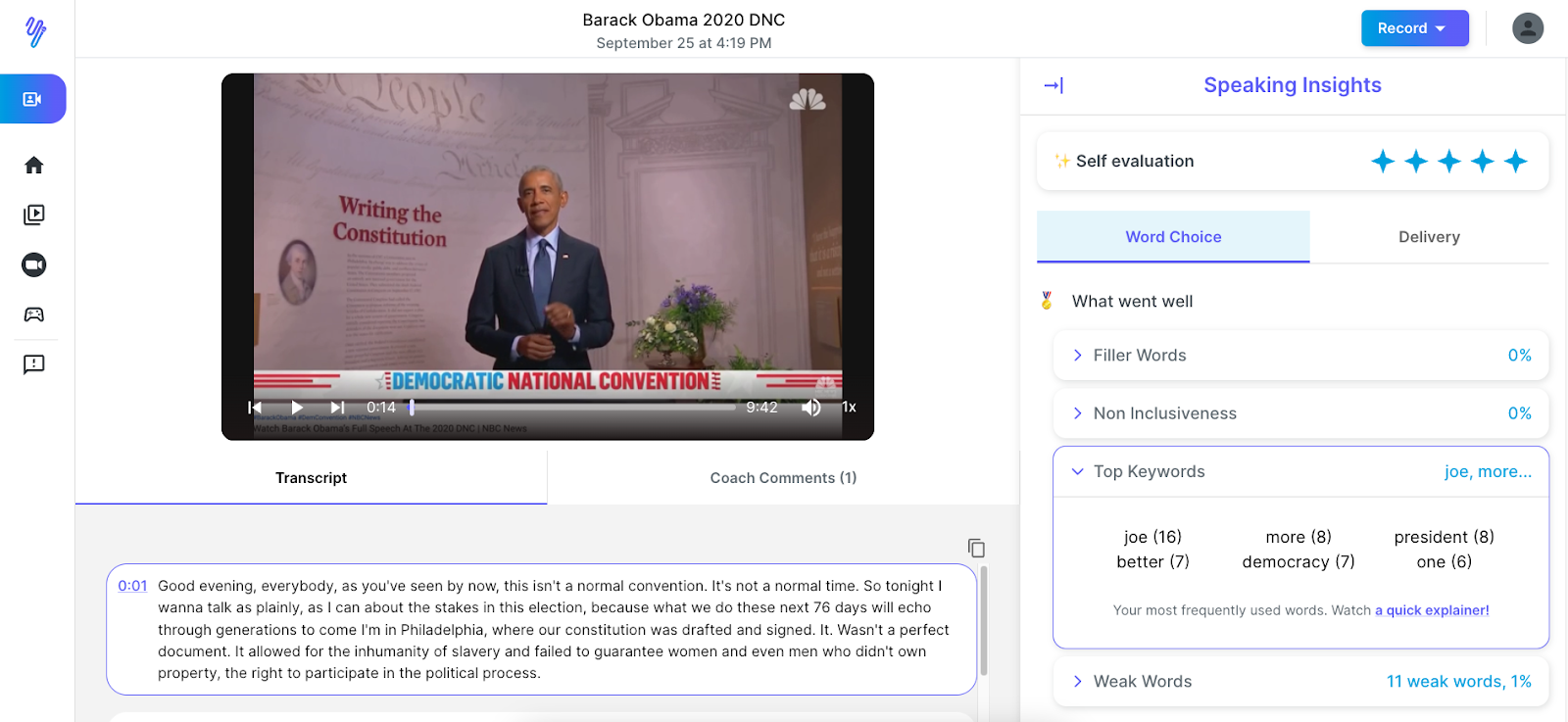
We’re not going to delve into the political aspects of Obama’s DNC speech, but we are going to take a deep dive into Obama’s visual, verbal, and vocal delivery. Let’s take a look at the real-time analytics from Yoodli AI speech coach for the first 10 minutes of the speech.
Obama’s DNC speech: speaking insights
Yoodli provides insights into two categories here: word choice and delivery. For each, the insights are organized into “what went well” and “what could have gone better.” (Although, for this speech, everything went well for these elements!)
Word choice: filler words
Obama used zero filler words such as um, uh, hm, and you know. The audience didn’t suffer through any wasted or distracting syllables. It’s clear that each word was carefully selected beforehand.
Several factors contribute to this excellent score:
Obama is an experienced and gifted speaker.
He read from a script. He didn’t have to stop and think about what to say next.
He rehearsed.
He took his time.
Word choice: non-inclusiveness
We see another flawless score here. While Obama’s DNC speech certainly included aspects that not everyone agrees with, he didn’t use language that could be taken as discriminatory or profane — words that could unnecessarily alienate someone or make them feel left out just because they’re a particular sex, religion, etc.
You’ll notice that Yoodli uses feedback such as “Nice work!” and “Great job!” when you do well. Whether you’re giving your first speech or you’re as polished as Obama, it boosts your confidence when you receive affirming feedback.
Word choice: top keywords
If you didn’t watch Obama’s DNC speech, you could look at the Top Keywords and see that he talked mostly about “Joe.” Considering the occasion, he was right on theme.
Yoodli’s Top Keywords feature helps you know whether you talked about what you aimed to talk about. It could reveal that you talk about yourself a lot, which you might not realize. You’re not tracking your word count, but Yoodli is, and these insights bring important issues to the surface.
Word choice: weak words
Obama used weak words 11 times, which is only 1% of his speech. That’s excellent! The Yoodli AI speech coach identified five instances of so, three instances of just, two uses of actually, and one seriously.
Weak words are words that, if overused, could indicate a lack of confidence. Generally, they don’t add anything substantive and can detract from the message.
Delivery: eye contact
In the Delivery category, Obama’s DNC speech hit on all cylinders, just as he did in the Word Choice category. The first score is for eye contact. The Yoodli AI speech coach shows that he made eye contact 72% of the time. Obama did well to confidently address his audience.
When you make eye contact with your audience — even when it’s through a camera — they feel more connected to you. You come across as more confident. Connection and confidence contribute significantly to getting your message across effectively.
Delivery: pacing & pauses
Obama’s pace was 129 words per minute — a smidge below average. It’s a relaxed pace that incorporates several deliberate pauses that Obama injected, giving his audience time to digest what he said.
Some might interpret the pacing as lacking a sense of energy and urgency. Obama’s speech wasn’t fiery, but it was earnest.
Obama’s DNC speech: a delivery homerun
It’s been said that the masterful delivery of Obama’s acceptance speech at the 2008 Democratic National Convention helped propel him toward electoral victory. It’s likely that this speech at the 2020 DNC contributed to Biden’s success in November.
Watch more of Obama’s speeches to keep learning from his delivery techniques. To discover how he learned the art of rhetoric, check out this article from writer and journalist Charlotte Higgins. Finally, practice your own public speaking skills at Yoodli for free, using the same AI speech coach that we used to analyze Obama’s DNC speech.
Even the most gifted orators benefit from practicing. Yoodli makes practicing fun and easy. Now’s a great time to start.