KindWork, a free workforce development program operated by Brooklyn Workforce Innovations, prepares low-income young adults in New York City for careers in customer experience and customer success. With only five weeks per cohort and a four-person program team, KindWork needed a way for fellows to practice interviews quickly, repeatedly, and against KindWork’s own frameworks rather than generic expectations. Using Yoodli’s customizable rubrics and AI roleplays, KindWork has enrolled roughly 90 learners across five cycles since spring 2025, with each fellow completing three to four interview rounds. Coaches now track interview readiness as an objective signal: in the most recent cycle, every fellow scoring 68 or higher on Yoodli reached an employment outcome, and 10 of 16 graduates either improved over time or remained consistently strong.
Background
KindWork has operated since 2019 with a clear mission: create an accessible pathway into technology through customer-facing roles that offer strong wages and career mobility, and prepare graduates to work alongside AI rather than compete against it. The program serves approximately 72 learners per fiscal year across four cycles, with 16 to 20+ fellows per cohort, and maintains an 85% graduation rate with in-sector placement rates in the mid-70s, competitive numbers for workforce development in tech.
Career readiness, not just technical training, is what fellows say they are most anxious about entering the program. And the interview process itself has changed: entry-level customer support candidates now regularly face AI interviewers as part of hiring, with three, four, or more rounds even for entry-level roles.
The Challenge
Before Yoodli, interview practice happened live with a coach or a peer. That worked, but with a five-week program, fellows needed to improve fast, and a four-person team could only run so many mock interviews. As Stephanie Tkach put it, running mock interviews for 25 people makes it hard to ensure every fellow gets feedback that is complete, actionable, and documented well enough to drive improvement the next time.
Other interview platforms didn’t fit. Their AI interviewed in a static way (ask a question, hear the answer, move on), which left fellows feeling uncomfortable and unauthentic. Questions were pitched at consulting or sales candidates, not the customer support roles KindWork trains for. Worst of all, generic platforms gave feedback that contradicted what KindWork taught in class, creating a disconnect that made them unusable.
The Solution
KindWork built its own interview frameworks directly into Yoodli and trained the AI to grade fellows against those frameworks, not a broad industry standard. Fellows practice roleplays introduced gradually across the program, starting with foundational questions like “tell me about yourself” and “why do you want to work here,” in a low-stakes environment at home after class. They can attempt a roleplay multiple times to hit a defined passing score, review recordings of past attempts, and improve through repetition. Each fellow completes three to four interview rounds, often with many attempts per round.
Critically, KindWork runs a human-in-the-loop coaching model. Coaches sit down with fellows after they receive Yoodli feedback to make sure they understand it and to add a human touch, like developing a story further. Scores, feedback, and improvement are tracked on the platform over time as the team’s way of assessing whether a fellow is ready to begin the job search in earnest.
“Yoodli has put us in the position to have AI help amplify our coaching, but not replace us. That’s really important for our team in wanting to maintain that human touch with our participants.”
– Shani Watler, KindWork Program Director
Why Yoodli
Customizable rubrics that match a bespoke curriculum. KindWork is one of very few customer support workforce development programs in the country. Stephanie defined what a one and a five look like based on the program’s own rubrics, used Yoodli’s built-in rewrite and preview features to refine how the AI assessed responses, and tested each roleplay herself before rolling it out.
Easy iteration. The platform makes it simple to go back into roleplays and edit frameworks as the curriculum evolves or something feels off.
Direct collaboration. Stephanie worked with Yoodli co-founder and Chief Customer Officer Esha Joshi to tailor the grading experience: “It felt like we were working on that together to help our fellows achieve the lives they dream of.”
Practice that feels real. Dynamic roleplays replaced the static Q&A experience that had made fellows hesitant to practice with AI at all.
The Results
~90 learners enrolled across five cycles in roughly 15 months, with every cohort since spring 2025 using Yoodli
Deep, repeated practice: the current cohort of 18 fellows has initiated 675 total practice sessions, averaging 37.5 practices per fellow as they refine their delivery
A readiness signal coaches can act on: in the most recent cycle, fellows scoring 68 or higher on Yoodli practices all reached employment outcomes, while scores in the low 50s flagged early who needed more coaching time
Measurable skill progression: 10 of 16 graduates in the last cycle either improved over time or remained consistently strong
Significantly more feedback from the same four-person team: assignment-level feedback increased across the fellowship, down to the specific framework a fellow needs to work on
Data-driven graduation standards: Fellows advance based on demonstrated skill growth, moving beyond intuition to objective performance metrics.
Confidence that outlasts the program: alumni continue using Yoodli in their job search, and even fellows placed outside the tech sector report that the practice prepared them for interviews while still achieving wage progression
“We don’t want people to spend five weeks and graduate without clear evidence that they’re ready. We’ve been able to significantly increase the amount of assignment-level feedback we’re giving our fellows, and really scale our coaching as a result.”
– Stephanie Tkach, KindWork Head of Career Services & Industry Partnerships
“Yoodli pushed me to practice in a way that felt challenging but useful, and the feedback helped me improve my responses over time. The interview simulation made the process feel real and prepared me to interview for the tech role I’m in now.”
– Elise D., KindWork Alum, Winter 2026 Cohort
What’s Next
Small class sizes are core to KindWork’s model, and that won’t change. But Yoodli has helped the program stay nimble as screening and selection processes in tech grow more complex, and it could support growth in other ways over time, like potentially offering classes more frequently. Shani is already encouraging peer programs across Brooklyn Workforce Innovations, in and outside of tech, to experiment: “Give it a shot and see how you can make this tool help make your coaching more robust and more meaningful for your participants.”
TL;DR:LAK Group, a boutique career and leadership development firm, partnered with Yoodli AI Roleplays to deliver scalable, on-demand coaching to enterprise clients across industries, from early-career professionals to senior leaders. By embedding their proprietary LAK communication, conflict, and feedback models directly into Yoodli’s customizable rubrics, LAK extended the reach of their live human coaching into a safe, judgment-free AI practice environment. The results: clients interview better and land jobs faster, sales teams in client organizations saw double-digit improvements in sales performance, and several organizations experienced up to a 50% reduction in employee turnover.
Background
LAK Group is a professional services firm operating two primary offerings: career coaching for individuals navigating growth and job transition, and enterprise leadership development delivered through their proprietary Oriel platform. Their client base spans recent college graduates through seasoned executives, with a particular focus on mid-level leadership populations inside enterprise organizations.
As demand for coaching at all levels in organizations scaled, LAK faced a challenge familiar to many high-touch service providers: how do you maintain the quality and personalization of career development through a balance of live coaching, assessment and learning adapted to each individual when large populations of learners at once while also enabling the ability to learn in the flow of work with practical experience?
The Challenge
LAK’s existing approach leaned heavily on microlearning videos to supplement their human coaching engagements. The results were underwhelming. Video content failed to drive meaningful engagement, and learners weren’t building the muscle memory that comes from actual practice.
The core problem was structural: live coaching is powerful but finite. A coach can only be in one conversation at a time. LAK needed a way to extend the impact of their proprietary frameworks, their models for conflict, communication, and feedback, into an on-demand format that felt personalized, not generic. LAK needed to help individuals learn in the flow of work with practical tools that anchored the right behaviors.
They also needed a solution purpose-built to serve diverse learner profiles across industries — one flexible enough to meet healthcare professionals like nurse managers and physicians, early-career talent, revenue producing professionals and people leaders where they were, including in the high-stakes conversations most tools aren’t designed to support.
The Solution
LAK Group partnered with Yoodli to bring their proprietary frameworks to life inside AI-powered roleplays. Rather than using off-the-shelf scenarios, LAK embedded their own communication, conflict, and feedback models directly into Yoodli’s customizable rubrics, ensuring every practice session reflected their methodology, not a generic coaching template.
The implementation included:
Hyperpersonalized Rubrics: LAK built rubrics rooted in their proprietary IP, so learners received feedback calibrated to LAK’s specific frameworks rather than boilerplate criteria.
Safe, On-Demand Practice: Learners could practice leadership conversations, interview scenarios, and communication skills on their own schedule, without the pressure of performing in front of a coach or colleague.
Enterprise ROI Dashboards: For each client organization, LAK built unique ROI dashboards to track engagement and outcomes, giving enterprise buyers tangible data on program performance.
Long-Term Cultural Activation: Beyond initial program delivery, LAK uses Yoodli to sustain culture activation long after the formal engagement ends. Even after the seven-month process of defining organizational cultural beliefs, employees can continue anchoring behaviors and leadership skills through self-directed Yoodli resources.
Why Yoodli
LAK evaluated alternatives before selecting Yoodli. Yoodli stood out immediately. The feedback felt natural and human-centered, the platform was flexible enough to reflect LAK’s nuanced methodology, and the experience was designed for the kind of coaching LAK actually delivers — not generic skill-building.
Yoodli stood out for its flexibility, adaptability, and its approach to feedback that felt natural rather than robotic. Critically, LAK wanted a technology partner they could grow with, an innovative team willing to build alongside them as their client base and use cases expanded.
As LAK looked ahead, the ability to integrate Yoodli with AI tools like Claude to design roleplays instantly aligned directly with their vision for “learning in the flow of work.”
The Results
Since implementing Yoodli AI Roleplays, LAK has seen measurable impact across learner confidence, client performance, and enterprise retention:
Improved Interview Performance: Clients utilizing Yoodli’s on-demand practice tools alongside live coaching sessions are interviewing better and securing jobs faster, with the combination of human coaching and AI practice proving more effective than either alone.
On average 9% – 12%Increase in Sales Performance: Across several enterprise client organizations using LAK’s Yoodli-powered programs, sales performance improved meaningfully, a direct result of reps building communication and objection-handling skills through structured, repeatable practice.
Up to 50% Reduction in Sales Team Turnover: In certain client sales organizations, LAK observed turnover rates drop by up to 50%. The combination of stronger onboarding, continuous skill-building, and culture activation programs supported by Yoodli contributed to significantly higher retention.
Expanded Coaching Reach into Mid-Level Leadership: LAK successfully scaled coaching engagement into mid-level leadership populations that previously received limited development support, a segment that is notoriously difficult to serve at scale.
Confidence Gains Across Diverse Learner Profiles: Healthcare professionals including nurse managers and physicians improved communication and leadership skills. Early-career professionals and introverted learners showed visible confidence gains after practicing with AI, overcoming initial hesitation to engage with the technology.
High Engagement After Initial Skepticism: While learners were initially apprehensive about AI-powered coaching, engagement quickly shifted once they experienced the benefit of practicing in a judgment-free environment. The psychological safety of AI practice unlocked participation from learners who would otherwise disengage.
What’s Next
LAK Group is actively expanding how they use Yoodli across in their Oriel Platform for both career development, career coaching and leadership development offerings. They are exploring deeper integration between the two platforms to create a seamless learning experience for enterprise clients, one that combines the cultural activation work of Oriel with the communication skill-building of Yoodli AI Roleplays.
As AI-native learning continues to evolve, LAK sees Yoodli as a long-term partner in their mission to deliver hyperpersonalized development at enterprise scale.
“We wanted to work with an innovative company we could grow with. The level of hyperpersonalization Yoodli gives us, embedding our own models into the rubrics, is vital to how we serve enterprise clients. Other tools were too dry and mechanical. Yoodli gave us the flexibility we needed.” — Michael Grubich, LAK Group
Case Study | Education & Language Learning | AI Tutor
TL;DR
Accepted Egypt, an intensive English language training program based in Cairo, partnered with Yoodli after evaluating multiple AI tools over more than a year. Yoodli was the only platform that delivered genuine two-way conversational AI, custom rubric-based scoring, and behavior-controlled AI personas, without requiring extensive prompting or technical expertise.
In 6 months: 75+ learners enrolled, 613+ hours of AI practice completed, 9.3k roleplay practices across ~260 lessons, 76% of learners improved by 20+ points on English speaking skills, and 47% graduates secured employment in Egypt’s Business Process Outsourcing (BPO) sector, with salary increases from 10,000 EGP to 22,000 EGP per month (2.2x).
Background
Accepted Egypt is an intensive English language training program that helps Arabic-speaking adults in Cairo enhance their English communication skills to qualify for higher-paying employment, particularly in Egypt’s rapidly growing BPO sector and call center industry.
The program takes learners from beginner (A1) to job-ready (B1+) proficiency within 60 to 90 days through a combination of daily instructor-led sessions and high-volume guided AI practice tasks.
Founded by Mohamed Farahat, a former Teleperformance Egypt quality analyst and recruiter, Accepted Egypt was built on a single insight: Egypt’s skilled labor market faces a structural gap. Global companies are relocating operations to Egypt driven by cost advantages (1 USD = 50 EGP), but consistently struggle to find workers with the English proficiency required for client-facing roles. Accepted Egypt bridges that gap, combining structured language instruction with AI-powered practice at scale.
Challenge
Before Yoodli, Accepted Egypt spent more than a year evaluating and using alternative AI practice platforms. Other tools missed the mark in these critical areas:
No Custom Content Upload
Most platforms come with pre-built content libraries that cannot be modified. This forced a painful choice: either adapt the institution’s curriculum to match the vendor’s content, or accept that students would practice tasks completely unrelated to what they learned in class. A student trained on describing personal memories in an Egyptian context would go home to practice tasks about topics like ‘Day of the Dead’, a culturally disconnected experience that undermined learning transfer and student motivation.
No Genuine Two-Way Conversation
The majority of tools operate on a ‘press a button, say a sentence’ model. Students repeat phrases or respond to static prompts. There is no back-and-forth, no follow-up question, no conversational pressure, no simulation of a real interaction. This is fundamentally different from what a BPO job requires, where an agent must listen, process, and respond dynamically in real time.
No AI Behavior Control
Some tools offer a form of conversational AI, but with no backend control over how the AI behaves. Building a realistic scenario required 30 to 45 minutes of detailed prompting, and even then the results were inconsistent and unpredictable.
Credit Exhaustion Kills Practice
Platforms simply stopped responding when credits ran out, mid-session, without warning. For a program that requires students to complete four practice tasks per day, five days per week, this kind of interruption is operationally unacceptable.
The Solution
After more than a year of evaluation, Yoodli was selected as the only platform that met all of Accepted Egypt’s core requirements simultaneously:
Genuine Two-Way Conversational AI English Training
Yoodli enables real-time, spoken back-and-forth dialogue. The AI does not just wait for a student to finish speaking, it engages, challenges, asks follow-up questions, and responds to what the student actually says. This mirrors the conversational demands of a real BPO role in a way no other evaluated tool could replicate.
Custom Content: Built Around Our Curriculum
Yoodli allows institutions to build practice scenarios from scratch using their own content. At Accepted Egypt, every AI practice task is built directly from the lesson taught that day: same vocabulary, same functional language, same context. Students practice exactly what they learned. This closes the gap between instruction and practice that undermined every other tool we tried.
AI Behavior That Works Without Extensive Prompting
Yoodli’s backend AI behavior system is the most significant differentiator. A prompt that would take 30 to 45 minutes to build on another platform takes 5 to 10 minutes on Yoodli, and produces better results. The AI understands context. If the scenario requires a frustrated customer who gradually calms down when handled professionally, Yoodli delivers that naturally. It does not need to be told every single thing, as long as the situation is set up correctly, the AI does the job.
Yoodli also provides a measure of prompt quality, indicating whether a prompt is likely to produce a strong, medium, or weak AI interaction. This feedback loop helped our instructors improve their content creation skills over time, without requiring any technical background in AI or prompt engineering.
Multiple Personas: Variety at Scale
Yoodli supports multiple AI personas within a single program. Students at Accepted Egypt are exposed to different conversational styles, accents, interaction patterns, and character types. From patient tutors to assertive interviewers to demanding customers. This variety prevents adaptation to a single AI voice and builds genuine conversational flexibility.
Custom Rubric-Based Scoring Across Five Dimensions
Every practice session at Accepted Egypt is scored across 5 speaking dimensions:
Fluency: smoothness and natural flow of speech
Grammar: accuracy of sentence structure
Pronunciation: clarity and intelligibility
Natural English: use of idiomatic, contextually appropriate language
Tonality: appropriate register, warmth, and professionalism
These rubrics are custom-built for each proficiency level (A1 through B1+), and become progressively more demanding as students advance. A score of 4/5 at A2 requires a higher standard of performance at B1, ensuring students are continuously challenged, not just repeating the same level of effort.
Results of AI English Training
Across 6 months of deployment, the Yoodli-powered program at Accepted Egypt delivered measurable outcomes across four dimensions:
Beyond the quantitative results, Accepted Egypt’s experience highlights several qualitative outcomes that speak to the AI Tutor‘s differentiated value:
Competitive tool replacement: After more than a year with previous solutions and evaluations of multiple alternatives, Yoodli was the only tool that met Accepted Egypt’s requirements for two-way conversational AI, custom rubric scoring, and scalable guided practice
Behavioral AI quality: Yoodli that the system “is smart enough so I don’t have to tell it every single thing, as long as I set up the situation, the AI does the job.” Compared to other services where prompting an angry customer persona required extensive effort and produced unrealistic extremes, Yoodli’s AI produced natural, context-appropriate responses with minimal prompting.
User-friendly design: Teachers with no AI or prompting background can create and manage practice scenarios, lowering the barrier to scaling the program beyond Mohamed’s direct involvement.
WHAT’S NEXT
Q2 2026: Scaling to 400+ Learners
Accepted Egypt is launching a major Q2 initiative targeting 400+ learners, partnering with educational influencers across Egypt to reach new audiences. Yoodli’s AI Tutor will serve as the core practice engine for this expanded cohort. The first institutional-scale AI English training deployment of its kind in Egypt.
AI Tutor-Led Instruction
Accepted Egypt is actively testing Yoodli’s screen sharing and PowerPoint integration to explore delivering full structured lessons, not just practice tasks, through the AI Tutor. If successful, this shifts the business model from instructor-dependent delivery to AI-led tutoring at scale. This allows the program to serve significantly more learners without proportional instructor overhead.
Beyond English: Finance, Management, and Professional Skills
The architecture Accepted Egypt has built on Yoodli, custom rubrics, progressive difficulty, persona-based practice, is not limited to language learning. Future programs will use the same framework to tutor learners on finance for non-financial professionals, people management, and business communication skills. Yoodli’s AI is smart enough to operate across domains as long as the situation is set up correctly, and Accepted Egypt intends to prove that at scale.
University Partnerships
Accepted Egypt is in early discussions with Egyptian universities to integrate Yoodli into their learning cycles, bringing AI-powered speaking practice to thousands of students who currently have no access to structured conversational English training.
The Middle East Opportunity
Egypt is not an isolated case. Across the Middle East and North Africa, the same structural gap exists: a growing demand for English-proficient workers in BPO, technology, and professional services, and a workforce that lacks the conversational practice infrastructure to meet that demand. The economic incentive is significant: in Egypt alone, the difference between a non-English-proficient worker and a B1-level English speaker is a salary increase of more than 100%.
Accepted Egypt represents proof that Yoodli can operate at institutional scale in this market, with measurable outcomes, high engagement, and real employment results. The opportunity to expand this model across the region is significant, and Accepted Egypt is positioned to be Yoodli’s regional implementation partner as that expansion unfolds.
ABOUT ACCEPTED EGYPT
Accepted Egypt is an intensive English language training program based in Cairo that helps Arabic-speaking adults enhance their English proficiency within 60 to 90 days to qualify for higher-paying employment in Egypt’s growing BPO and technology sectors. The program combines daily instructor-led sessions with AI-powered guided practice to deliver rapid fluency gains at scale.
ABOUT YOODLI
Yoodli is a secure, experiential learning platform that uses AI roleplays to help individuals and teams practice real-world conversations, presentations, and professional interactions. With AI Tutor, AI Roleplays, and continuous coaching, Yoodli closes the loop between learning, practice, and real-world performance. The Seattle-based company is trusted by Fortune 100 companies, leading training providers, and educational institutions to deliver scalable, judgment-free coaching across sales, leadership, customer success, and language learning. Learn more at yoodli.ai.
The LHH Interview Center builds interview and networking confidence while supporting self-guided learning and AI skill development for today’s evolving job market.
NEW YORK, NY – August 5, 2025 – LHH, the integrated professional talent solutions provider and global business unit of the Adecco Group, today announces its global roll out of the new LHH Interview Center that is a part of the LHH Career Studio.
Designed for people navigating career transitions worldwide, the LHH Career Studio is a digital platform that leverages 50 years of industry expertise, behavioral science and advanced research to deliver a dynamic suite of career solutions. With AI-driven features, real-time job market data and professional coaching, the LHH Career Studio supports over 500,000 candidates and thousands of organizations annually, across over 60 countries worldwide.
The LHH Interview Center helps candidates master interview skills through realistic simulations, smart responses and live feedback. Its private, customizable experience builds soft skills on demand, enabling job seekers navigating career changes to feel prepared and in control of their next step.
In the LHH Interview Center, an AI interviewer engages users in practical roleplay by asking contextual questions, responding dynamically and providing actionable commentary on delivery, content and communication style. This platform supports multiple interview formats where users can customize their practice to tailored questions based on job descriptions, to ensure preparation is both relevant and effective.
“At LHH, we are committed to providing the most innovative candidate experience in the market, with human need at the top of mind,” says John Morgan, President of LHH’s Career Transition & Mobility, Leadership Development & Coaching and HR & Talent Advisory. “Technology can scale career transition support, but empathy is at the core of any transition work. In today’s shifting job market, we are evolving our tools to meet the needs of candidates facing unpredictable career transitions. The LHH Career Studio is intentionally designed so candidates can be successful, and the LHH Interview Center equips job seekers to build self-awareness and trust in their skills, helping them find better-fit opportunities faster.”
Launched in the United States earlier this year and now expanding globally, the tool has seen strong adoption and enthusiasm. Many users return for multiple sessions, with some completing more than 300 practice sessions.
Recognizing that even the most advanced algorithms cannot replace genuine human support, LHH Career Transition coaches and talent leaders help candidates interpret the data and skills identified by the tool. The AI-garnered insights allow coaches to focus more deeply on relationship building, guiding candidates through the emotional challenges of career transition.
“The combination of Yoodli’s cutting-edge technology with LHH’s career transition expertise has resulted in a thoughtful, pioneering and content-rich solution,” says Varun Puri, CEO and Co-Founder of Yoodli. “Candidates describe it as an immersive simulation experience, especially valuable for those who have not interviewed in years, are changing career paths or have limited opportunities and cannot afford to fail. It is also a confidence booster for those anxious about what might come up in a real interview.”
The LHH Interview Center is now available on Career Studio in the U.S. and is being rolled out for all LHH Career Transition candidates globally in September this year.
For organizations looking to empower transitioning talent, learn more about how to inspire career transformation with the LHH Career Studio.
###
About LHH
LHH empowers professionals and organizations to achieve bold ambitions and secure lasting impact through unique advisory services and professional talent solutions.
LHH’s full suite of offerings connects solutions that are traditionally siloed, making LHH a single talent partner for organizations. In a rapidly evolving landscape with complex challenges, we create value across the entire professional talent journey. From hiring great people, developing skills and nurturing leaders, to advancing individuals to the next stage of their careers, LHH makes talent a competitive edge.
We believe the future of work lies at the intersection of exceptional human care and innovation. Powered by science, technology, and proprietary data analytics, LHH’s approach is crafted to align with business strategies and cultures, delivering powerful, sustainable, and measurable impact.
LHH has a team of over 12,000 professionals, across 60+ countries and more than 50 years of experience. As part of the Adecco Group, we bring together global excellence, local knowledge and centralized coordination for thousands of companies and millions of people worldwide.
Yoodli is the market leader in AI-powered communication coaching. Trusted by Fortune 500 companies, business schools, and coaching organizations, Yoodli helps individuals improve sales pitches, public speaking, interviewing, and persuasive communication through interactive roleplay and data-driven feedback. Its AI technology enables scalable and personalized practice for every professional.
@ASCEND, a leading career coaching company, and Yoodli, an AI-powered communication coaching solution, are thrilled to announce a strategic partnership designed to elevate career coaching with cutting-edge AI-driven training. This collaboration integrates Yoodli’s advanced speech coaching technology with @ASCEND’s career expertise, enabling professionals to refine their communication skills and accelerate their career success. Introducing InterViewIQ, @ASCEND’s AI-powered communication and career coach.
A New Era of AI-Powered Career Coaching
@ASCEND is a go-to for career coaching, promotion strategy, leadership development, and communication. Now, with Yoodli’s AI-powered coaching, clients can seamlessly enhance their interview techniques and presence with real-time, personalized feedback.
Through this partnership, professionals will be able to:
Master Interview Performance – Receive AI-driven feedback to refine answers, minimize filler words, and enhance confidence.
Enhancing Professional Presence – Strengthen clarity, tone, and delivery to command the room with impact.
Leverage AI-Powered Coaching Anytime – Gain access to personalized, data-driven insights tailored to career goals.
Track Measurable Progress – Monitor improvements in speech patterns, pacing, and overall communication effectiveness. Measure success with structured goals, including delivering key talking points, applying the STAR method, and maintaining authenticity.
Unlocking New Opportunities
@ASCEND clients will now have exclusive access to Yoodli’s AI-powered coaching as part of their premium package/InterViewIQ, offering:
Smart AI Feedback – Integrated coaching to accelerate skill development.
Better Career Outcomes – Enhanced preparation for interviews and executive speaking to secure top roles.
Data-Driven Insights – Analytics on clarity, pacing, and confidence for continuous communication improvement.
Leadership Perspective
Christopher Ellis, Founder & CEO of @ASCEND said, “We are thrilled to partner with Yoodli to launch InterViewIQ, a transformative AI-powered tool that empowers professionals to refine their communication skills with real-time, judgment-free feedback. This collaboration combines Yoodli’s cutting-edge technology with our expertise in career coaching at @ASCEND, offering a game-changing resource to our Clients who are looking to excel in interviews, presentations, and beyond—confidently and authentically.”
About @ASCEND
@ASCEND empowers professionals to excel in their careers by offering expert coaching in leadership development, career navigation, and executive presence. By integrating AI-driven training, @ASCEND helps clients build the skills they need to succeed in today’s competitive job market. Learn more here.
About Yoodli
Yoodli is an AI-driven communication coaching platform that provides private, real-time, and judgment-free feedback. Trusted by professionals, top business schools, and organizations like Toastmasters International, Yoodli helps individuals refine their speech, confidence, and executive presence. Learn more here.
@ASCEND and Yoodli share a vision for helping professionals advance their careers through exceptional communication skills. This partnership delivers an innovative solution that empowers individuals to achieve their professional goals with confidence and clarity.
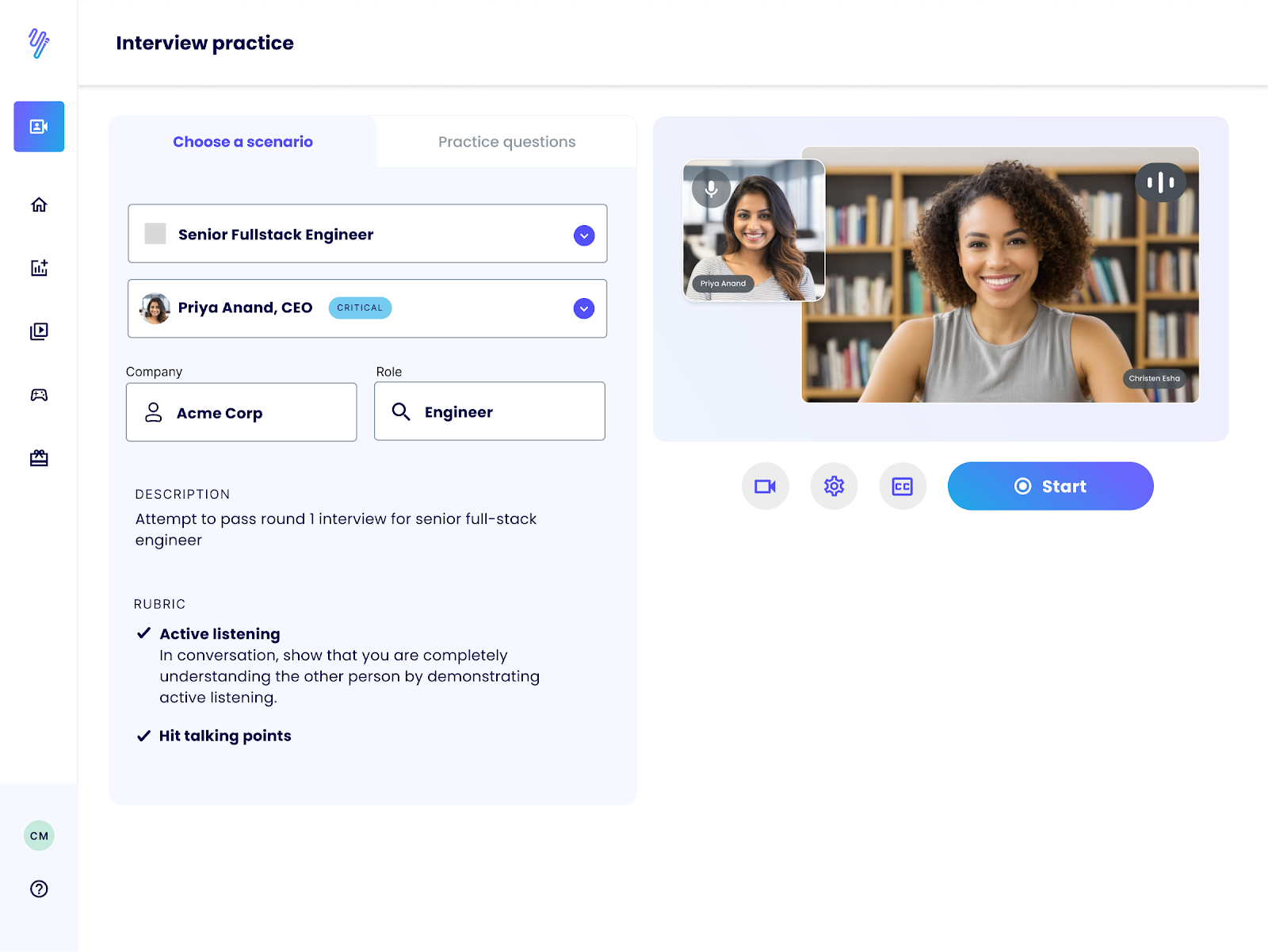
Say hello to Interview Roleplays, the ultimate tool to take your prep game from meh to wow! Whether you’re practicing for a behavioral interview or a technical assessment, this new feature allows you to create realistic, role-specific roleplays with ease. Build confidence and refine your skills to approach your next interview with clarity and readiness.
What’s an Interview Roleplay?
Think of it as your personal interview simulator. Pop in the job details—manually or let Yoodli’s AI do the heavy lifting from a PDF or job description link—and voilà! A tailored mock interview just for you. It’s all about prepping smarter, not harder.
Interview roleplays are designed to empower you to ace your communication skills in every professional setting. It’s seamless, smart, and all about helping you shine.
Why You’ll Love It
Custom Practice: Tailor interview roleplays for specific roles and companies, ensuring relevance and preparation for your target interviews and because no two jobs are the same.
AI Interviewer: Chat with an AI interviewer, making practice sessions realistic and effective.
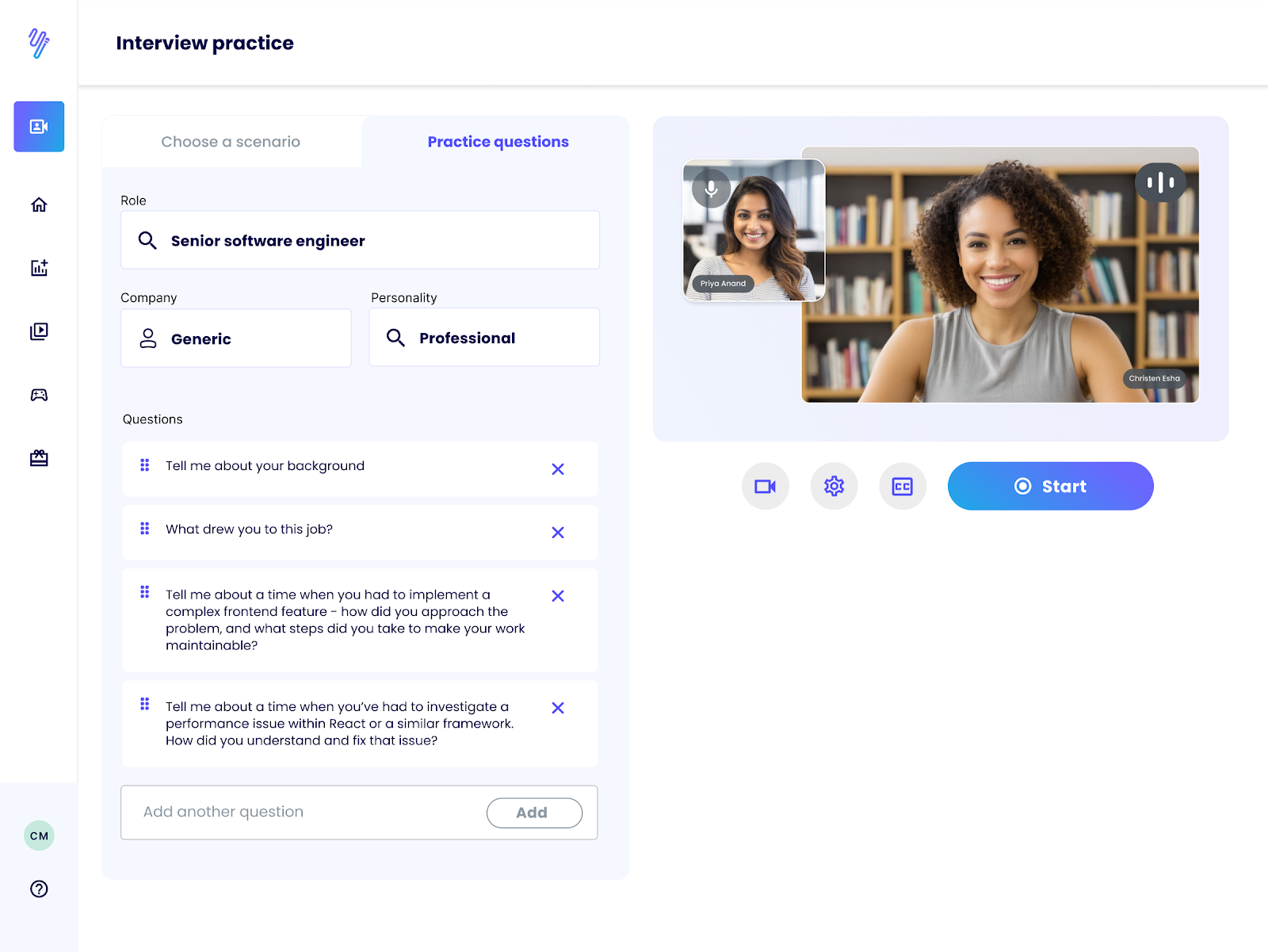
Total Flexibility: Access question banks, create your own, or add one-off questions to align practice with your needs.
Effortless Setup: Quickly upload job descriptions or links, and let Yoodli handle the details to save time and effort.
How It Works
Create a Scenario: Pick a technical or behavioral interview and input job details manually or via PDF upload, or with a job description link.
Add Context and Questions: Enrich your roleplay with relevant context and potential questions from Yoodli’s extensive question bank or your own custom list.
Practice and Perfect: Select the scenario in “Choose a scenario” mode to engage with the AI interviewer or focus on specific questions in “Practice Questions” mode.
Try It Out
Don’t leave your dream job to chance. Log in to Yoodli and give Interview Roleplays a spin. It’s fast, fun, and designed to help you shine. Got questions? Our support team’s got answers at support@yoodli.ai
We built this for your success—so let us know what you think! 🚀
If you’re looking to make a little extra cash, finding a product tester job might be a good option for you. It’s a cool way to not only make some money, but also to explore and engage with new products and brands.
In our comprehensive guide, we’ll tell you everything you need to know about product tester jobs, from the types of positions, how to get a job testing, and which companies offer these kinds of roles.
What Are Product Tester Jobs?
Product tester jobs are positions that allow people to get paid for testing a company’s products or services. If you like to work from home or are looking for a remote job, product tester jobs could be a good choice.
How to Use AI to Practice Interviewing for Product Tester Jobs
If the product tester job you’re interested in requires an interview, practicing interviewing is a great way to prepare. Leveraging an AI-powered tool like Yoodli makes this even easier.
Yoodli is an AI-powered interview coach that evaluates your interview skills to give actionable feedback you can use to improve. It’s a completely customizable experience which makes it one of the most realistic interview simulators out there.
Practice interviewing for your product tester job with Yoodli.
To start, choose a role and company to apply to. If you don’t have a specific company or role you’d like to practice for, you can leave these blank for a more generalized experience.
Then, select your AI interviewer’s personality. You can experiment with an AI interview who’s more friendly, reserved, or professional, among other options. Finally, you can pick specific interview questions you could get asked for product tester jobs so you’re prepared for whatever comes your way.
Yoodli can easily help you prepare for your next product tester job interview.
While you answer these interview questions, Yoodli analyzes how you answer. Based on your responses, this tool gives you not only metrics related to your speaking but also direct input you can use to elevate your interview skills.
Set yourself apart from the crowd with some dedicated practice for best results. Just be sure to use the STAR method while answering to make sure your responses are thorough.
Types of Product Tester Jobs
Product tester jobs are versatile in that there are tons of positions across a number of different industries and areas.
Here are five types of product tester jobs that could be right for you.
Accessibility product tester jobs
Accessibility testing is a type of product tester job that ensures the product is user-friendly and accessible for those with disabilities. Companies that prioritize DEIB often offer accessibility testing.
For example, if you work in this area, you’ll likely:
Use assistive devices (such as screen readers) to make sure the product is accessible and works as it should
Pinpoint obstacles that crop up
Offer up feedback to improve the product with the disabled community in mind
Beta testers
Another common product tester job is beta testing. Before products are released to the market, beta testers will evaluate them for any bugs, issues, or other problems. The goal for beta testers is to pinpoint these issues beforehand to improve the experience of users.
For those interested in beta testing, you should prepare to do tasks like:
Completing surveys about the product
Using the first version of the product to test it
Participating in feedback forums
Pinpointing and reporting issues
Usability product tester job
With usability product tester jobs, the focus is on how user-friendly the product or service is. The goals of usability testing include evaluating how easy (or difficult) it is to use a product and how simple it is to learn how to use it. Usability product testers also aim to get a better idea of how the user experience is for people using apps, hardware, websites, and software.
In this position, some of the responsibilities you could have include things like:
Checking out different prototypes for websites, apps, and various hardware and software
Giving direct feedback to the designers or creators
Pinpointing potential issues
Game testing
For some people, becoming a game tester is a dream come true. Game testing is a type of product tester job that attracts many creatives. Although it might seem endless fun, it’s more than just playing games.
The main objectives for game testing are to pinpoint any glitches or bugs and to make sure from a user perspective, that the game is fun to play.
As a game tester, you’ll probably do things like:
Experiment and play through the game’s levels to identify and report glitches, bugs, or other areas of concern
Offer your thoughts and feedback on aspects of the game, including the storyline
Be a participant in internal sessions for playthroughs and discussion
Quality assurance product tester jobs
Quality assurance product testers (also called QA product testers) evaluate the quality of a product. Their main job is to search for any mistakes, bugs, or defects in the product before the product officially launches. QA product testers often test hardware and software.
If you’re interested in a QA product tester job, be prepared to do things like:
Collaborate and work with developers to solve issues
Learn and follow regulations set by the developer
Pinpoint and report bugs and other problems
Use test cases
How to Score a Product Tester Job
The first step in getting a product tester job is deciding what areas you’d like to work in, be it video games, cosmetics, apparel or something else entirely. Once you’ve nailed down what you want to do, the next step is perfecting your resume and cover letter.
Make sure you include all of your relevant work experience and any special high income skills that might make you more of an asset as a product tester.
Networking is extremely important when looking to find a product tester job. Connections are everything. Start by seeking out professionals in the product testing industry and connecting with them. You can get advice and ask questions related to product testing that they might be able to answer.
A great place to start is LinkedIn, but you can also attend events, conferences, and even join online forums and groups.
Companies That Offer Product Tester Jobs
There are loads of companies and brands scouting for potential product tester job applicants. Usually, they hire on an “as needed” basis.
Here are some of the top companies that offer product tester jobs.
Amazon product tester jobs
Not surprisingly, Amazon product tester jobs are pretty common. To find one, look for Amazon reviewer websites. These sites are usually scouting for testers to test and review their products.
Amazon offers a service called “Amazon Vine,” which is an invitation-only product tester job. People who use Amazon often and leave thoughtful reviews on the site could be invited to be a “Vine Voice” — AKA, an Amazon product tester.
Product tester for Nike
To be a product tester for Nike, the process is very similar. You’ll start by applying to be a product tester for Nike. If you’re chosen to move forward, you’ll get a test packet and a product to test.
The job mainly entails the product tester testing the item and then sending Nike feedback via its website. Lastly, you return the product and the process starts all over again with a new item.
Other companies that offer product tester jobs
Besides Amazon and Nike, there are also other companies offering product tester jobs when needed.
Some of the most sought-after brands for product testing opportunities are:
Because product tester jobs are so desired, there are a lot of frequently asked questions surrounding this industry and the work that comes with it.
Here are the most common FAQs potential product testers have.
Is being a product tester legit?
Being a product tester is a legitimate job. However, there are tons of product tester jobs that are actually scams posing as product testing opportunities.
Always be wary of these types of scams. If the request for product testing has lots of typos and grammatical errors, it could be a scam. It’s better to be safe than sorry.
Do product testers get paid?
Generally, yes, product testers get paid. However, that doesn’t mean all product testers across the board get paid.
Instead, companies and brands might offer compensation in ways besides a paycheck, including:
Gift cards
Free samples or “swag”
Points that can eventually be exchanged for money or products
Permission to keep the products they test
How much do online product testers make?
The amount of money you make as an online product tester depends. On average though, an online product tester makes about $37 per hour.
Still, keep in mind that product testers usually aren’t salaried employees, so this hourly rate will depend on how many jobs and products you’re testing.
Is product testing a good side hustle?
Yes, product testing is a great option for a side hustle. Although it’s not for everyone, plenty of people love the freedom that comes with product tester jobs and the new and exciting items they get to evaluate.
Can anyone become a product tester?
Anyone who wants to become a product tester can become one. There’s no special certifications, qualifications, or degrees a person needs to have to be able to score a product tester job.
Do product testers get free stuff?
Occasionally, product testers do get free samples and brand “swag.” Still, not every product tester will get free things.
Many product tester jobs require the tester to ship back the product after they’ve evaluated it instead of keeping it. It all depends on the company that hires you.
The Bottom Line
Product tester jobs are a hot commodity and finding an opportunity can be tricky. If you have any interest in product testing, definitely explore some of the types of jobs available.
If the product tester job you’re interested in requires an interview, just don’t forget to practice beforehand.
Whether you’re looking to earn some extra cash during the weekends or you just want a change of pace, night shift jobs can be a solution. Although they’re not for everyone, plenty of people enjoy and even prefer working nights as opposed to daytime hours.
Our guide on night shift jobs will give you an overview on this type of work, including what industries are often hiring, how to prep, types of positions you might prefer, and tips for working a successful graveyard shift.
What’s a Night Shift Job?
In general, a night shift job is a type of job where people work overnight. There are tons of other names for night shift jobs, such as:
Graveyard shift
Evening shift
Third shift
Closing shift
Midnight shift
Businesses offer night shift hours to extend their service beyond the typical 8 hours most companies are open for.
Industries that offer night shift jobs
There are lots of industries that offer night shift jobs, especially in the healthcare industry. Healthcare in particular is a critical service that needs to function at all hours.
Other industries that offer night shift jobs include:
Retail
Travel services, like airlines and hotels
Customer support
Hospitality services
Security
Long-term care
Food service
Journalism and news
Manufacturing and utilities
Emergency services
How many hours are night shift jobs?
The amount of hours night shift jobs offer can vary. The starting and ending times for a night shift job depends on the type of job and how long the business is open.
For example, if the business is open 24/7, the hours of the night shift could be from 10 p.m. to anywhere from 6 to 8 a.m. It also just depends on the employer’s preference and needs.
If it’s not a 24/7 business, the night shift will just refer to the “later” shift, whenever that may be.
What are most night shift hours?
Most night shift hours begin in between 10 p.m. and midnight and end somewhere from 6 to 8 a.m. As mentioned above, this can totally depend on both the industry and the employer.
What percent of America works the night shift?
About 7.4% of the working population — around 11 million adults — work the night shift often. Working night shift jobs is more common among men and people of color, as well as younger age groups, the largest being those between 18 and 29 years old.
How to Use AI to Practice Interviewing for Night Shift Jobs
If you’re interested in scoring a night shift job, one of your first steps to prepare is practicing interviewing. For the most realistic practice interview experience, try an interview simulator like Yoodli.
Yoodli is an AI-powered interview coach that evaluates your speaking patterns and speech as you answer practice interview questions. It then provides a report of your individualized metrics and makes data-backed recommendations to improve.
Whenever you’re ready to start interviewing for night shift jobs, give this AI interview coach a try.
You can get started for free any time. This app is also available to download to your desktop, too. Here’s how it works.
The interview flow is totally customizable, meaning you can tailor it to your specific needs. For example, if you want to practice company-specific questions (like Walmart interview questions) or industry-specific questions (such as content marketing interview questions), you can easily do so.
You can enter the position title of the role you applied for and the company for specifics, or you can leave that as general. You’ll also be able to change the “personality” of the interviewer so you can get the most realistic experience.
If you’re interested in exploring night shift jobs, this is a great way to prepare.
Types of Night Shift Jobs
One of the best things about night shift jobs is that they’re so versatile. No matter what type of work you’re interested in, there’s plenty of opportunity.
Here are some of the most common types of night shift jobs to explore.
Healthcare night shift jobs
One of the biggest industries for night shift jobs is the healthcare system. Healthcare settings like hospitals, mental health facilities, and long-term care require people working around the clock.
For example, some of the most common healthcare night shift jobs include positions like:
Nurses
Lab techs
EMTs
Paramedics
Pharmacists
Certified nursing assistants
Long-term care aides
Crisis hotline workers
Retail overnight jobs
It’s also really common to work the graveyard shift when you’re in the retail industry. Places like groceries, casinos, convenience stores, online shops, and entertainment venues usually have late night shifts.
Some of the most common positions include jobs like:
Cashiers or clerks
Security guards
Stockers
Warehouse workers
Bartenders and other servers
Manufacturing and utilities
The manufacturing and utilities industries also offer lots of night shift jobs for people looking to work overnight. Places like power plants and factories are often open late at night, if not 24/7.
People who work in transportation also work at night often. People like train conductors and truck drivers have responsibilities that lead to them working late.
Other late-night manufacturing positions include roles like:
Assembly line workers
Maintenance technicians
Plant operators
Dispatchers
Shipping and receiving personnel
Machine operators
Quality control inspectors
Customer service
Similar to other industries, people are constantly in need of customer service. That’s why 24/7 customer service lines have become so popular.
For example, call centers are often open for 24 hours a day. People like sales reps, customer service reps, and technical support specialists are on call at all hours.
Other types of customer service night shift jobs include positions like:
Hotel or motel front desk agents, housekeeping staff, and security guards
Delivery service warehouse workers and drivers
Airport and airline staff, baggage handlers, security, ground crew, and ticket agents
Night shift jobs in professional services
The professional services industry also offers these types of night shift hours. People who work in broadcasting, media, and journalism often work late thanks to the 24/7 news cycle. Other areas in this industry include software development and IT, finance, accounting, and law enforcement.
Those interested in working night shift jobs in professional services have tons of options, such as:
Radio DJs
Broadcast news anchors
Network admins
Programmers
Night auditors
Investment analysts
Police officers
Firefighters
TV producers
Editors and other journalists
Cybersecurity specialists
Web developers
Security guards
Paramedics
Part-time night shift jobs
Many industries also offer part-time night shift jobs. Part-time positions allow you to build on your existing skills and boost your income without having to commit to a full-time role.
Part-time night shift jobs are available in most, if not all, of the industries and areas listed above. Specifically, you might have better luck finding a part-time night shift job in roles like:
Pharmacy technician (in healthcare settings or places like CVS Health)
Emergency medical dispatcher
Nursing assistant
Social media moderator
Customer service rep
Virtual assistant
Cashier
Delivery food driver
Instacart shopper
Creative freelance work can be another worthy part-time night shift job option, since you can work during the night at your own hours. For example, freelance writing, editing, graphic design, and pottery are all different paths that allow you to express your creativity while also diversifying your income.
Work from home night shift jobs
Although they’re tricky to find, there are work from home night shift jobs that exist. In general, your best bet is likely freelance work, since many freelance work options allow you to work remotely on your own time.
Other options for work from home night shift jobs include positions like:
Graphic designer
Software tester
Virtual assistant
Social media moderator
Customer service representative
Data analyst
Interpreter or translator
Warehouse night shift jobs
One of the most popular types of night shift jobs are warehouse night shift jobs. These include a variety of positions in warehouse settings.
People who work warehouse night shift jobs usually have roles that fall into one or more of the following areas:
Providing maintenance and support, such as janitorial work, machinery maintenance, and loading and unloading trucks
Working directly with products, like packing items, quality control, forklift operation, etc.
Supervising or managing, such as managing inventory or a team of people
Warehouse night shift jobs also offer advantages like opportunities for promotion.
Benefits of Night Shift Jobs
There are definitely some unique benefits to night shift jobs that make them stand out from day shift positions. Some of the most notable benefits of night shift jobs include:
Financial advantages, including pay
General flexibility
Opportunities for growth and development
Financial advantages
Working night shift jobs has financial advantages, even beyond wages. However, pay is a big motivator when it comes to this type of work. The biggest advantage is the premium pay, since the majority of companies offer higher hourly pay for those working the graveyard shift. This increase in pay is usually tied to the fact that people who work the night shift have the inconvenience of a disrupted sleep schedule.
The other notable financial advantage comes from the fact that there’s not as much competition for night shift jobs. Because later shift positions often result in less candidates, you have a better chance of getting an offer. At the same, you’ll be more likely to progress faster in terms of your career advancement since there’s less competition.
Flexibility of night shift jobs
There’s also a flexibility to night shift jobs which can translate to an improved work-life balance. For example, when you work the later hours, your weekdays are now free. Although you’ll likely spend much of the weekday sleeping, you still have “extra” time to run errands while the rest of the world is at work.
If you consider yourself a night owl, finding a good night shift job can actually benefit your energy levels and sleep quality, since you can adjust to your natural circadian rhythm. Plus, working night shifts — which are generally less crowded, quieter, and more relaxed — can make it easier to focus and be productive. Chances are, you won’t be constantly interrupted while doing your work like you could be at a daytime job with lots of coworkers.
Growth and development opportunities
As mentioned above, because night shift jobs are less common, there’s less competition from applicants and colleagues alike. You’ll have more opportunities for growth and development, and can often progress faster in your career.
You’ll also grow in your skills and capabilities, as you’ll learn new things working a night shift job. For example, working independently, being self-motivated, and being adaptable are all great skills present in graveyard shift positions.
There’s also an enhanced sense of camaraderie among night shift job workers, as working together at night fosters community in a different way than in a day shift job. You’re more likely to bond with your coworkers and lean on them for support.
Challenges of Night Shift Jobs
That’s not to say that there’s no drawback to night shift jobs. There are a few challenges and other things to consider before picking up a new role. Here are some of the downsides you should keep in mind.
Sleep disruption
Perhaps the most obvious drawback of scoring a night shift job is the disruption to your sleep cycle. Everyone has a natural circadian rhythm and working late can disturb your usual cycle. This can lead to feeling tired during the day and having trouble falling asleep.
The long term effects of getting less quality sleep include conditions like:
Depression
Stroke
High blood pressure
Heart disease
Obesity and overweight
Diabetes
Kidney disease
Another factor of working a night shift job that affects your sleep quality is working under artificial light. When you’re working at night under artificial light, these conditions can slow your body’s production of melatonin, which only makes things worse.
Potential safety concerns
There are also some potential safety concerns to consider. One of the main dangers to look out for is the increase in accidents during night shift jobs. In part, being sleep deprived and feeling tired can affect your reaction time and judgment, which can lead to accidents. Although accidents can happen during daytime shifts too, they’re more common at night shift jobs.
Although it’s not true in every case, working night hours can put you more at risk for violence or being mugged. This is more of a concern if you work alone.
Lastly, it can be tough finding a safe way to get to work if you can’t drive yourself or don’t have a vehicle. The options for public transportations are extremely limited during the late hours of the night in many places, even if you live in a larger city.
Other challenges of night shift jobs
Some of the other challenges of working night shift jobs that you might want to consider include the isolation factor of working late hours. For example, you might not be able to spend as much time with your friends and family members if you typically work at night and sleep during the day.
You might also have trouble with daytime fatigue. After working all night, it’s only natural to feel tired after your shift. This can become problematic when you want to run errands or spend time with other people during the day.
It can be more difficult to stay productive, too. Many people feel drained and as a result, are unproductive, especially when it comes to the things they like to do for fun.
Why is a night shift so hard?
A night shift can be difficult for many people. For people who have always worked daytime hours and sleep at night, it can be hard adjusting to a completely opposite schedule. Not only can it be difficult adjusting sleep-wise, but also socially. You’ll need to put in dedicated time to spending time with friends and family — perhaps on the weekend — since they’ll likely be working while you’re sleeping and vice versa.
This “reversed” schedule can also lead to more stress, which makes working night shift jobs even more tough.
Are night shifts unhealthy?
Many people are quick to say night shifts are unhealthy, but health encompasses many aspects of your life. It’s true that there are some health drawbacks when it comes to night shift jobs, such as an increased risk of:
Daytime sleepiness and fatigue
Insomnia
Sleep deprivation
Digestive problems
Chronic health conditions
However, it’s complicated because everyone is different. Working a night shift job can affect people on varying levels based on their work environment, genetic makeup, overall health, and lifestyle.
6 Tips for Working Night Shift Jobs
Because night shift jobs have their advantages and disadvantages, some people have trouble deciding whether or not it’s worth it. If you’re curious about habits that can potentially improve your time working the graveyard shift, you’re in good company
Here are the six best tips for working night shift jobs.
1. Experiment with meal planning.
One of the aforementioned risks to working night shift jobs is experiencing digestive issues. That’s because people who work at night don’t always eat regular meals and if they do, they’re not always on a regular meal schedule. Because there’s such a lack of food options during the graveyard shift, it can be hard for people to find healthful, nutritious meals.
However, meal planning can help with this. Try packing your lunches for the week on Sunday or morning morning. That way, they’ll be in the fridge ready for you when you leave for work. You won’t have to try to find open restaurants or drive-thrus.
Some quick and easy meal plan ideas that are perfect for meal prep include options like:
Sandwiches and wraps with a main protein, veggies, and a condiment, sauce, or dressing
Pasta salad with veggies and a dressing
Protein bowls with a central protein, veggies, rice, and a dressing of your choice
Salads, like Mason-jar salads or more hearty salads made with quinoa
You can also prepare breakfast items to take with you on your commute to your night shift drive, like overnight oats, frozen breakfast sandwiches, or wraps you can warm up before you go.
It’s a good idea to pack some snacks as well, just in case. Healthful snack options could include things like:
Roasted seaweed
Hard-boiled eggs
Granola bars
Mixed nuts
Hummus and veggies
Be sure to stay hydrated, too. Using a reusable water bottle can make all the difference.
2. Continue to be active.
Even though it can be harder when you have a night shift job, try to stay physically active. About 30 minutes per day during the weekdays and weekends is perfect. Physical activity doesn’t have to mean going on a run or going to the gym either. You can be active by doing things like:
Stretching
Yoga
Gardening
Walking up and down stairs at work
Household chores like vacuuming or laundry
Going on a short walk on your break, before work, or after work
Remember to also soak up as much vitamin D as you can. Once you’re up and moving for your night shift job, try to go outside for a brief walk to get some sunlight. It’ll not only boost your move, but it can help maintain your sleep cycle.
3. Boost your sleep quality.
Sleep is even more important to consider when working a night shift job. The most critical thing to focus on is your sleep quality. If you don’t get good sleep, there are tons of tips to improve the quality.
It’s essential to stay on a schedule, even if you work late at night. If you typically sleep during the day and work tonight, be consistent. Try not to switch up your routine throughout the week. This can work wonders for your circadian rhythm.
As part of your schedule, make sure you have a solid bedtime routine. Instead of scrolling on your phone before bed, try to incorporate some more relaxing tasks, such as:
Reading a book
Listening to calming music
Taking a hot bath
On top of that, make sure your bedroom is a sanctuary for sleep by giving it a makeover. The goal is to have a cool, dark, quiet environment in which you can sleep peacefully. If daytime noises keep you awake, try earplugs or noise-canceling headphones. You can also install blackout curtains to block any light that might disrupt your sleep.
Try to steer clear of any stimulants, even while at work. Experts recommend putting a limit on how much alcohol and caffeine you drink since both can affect the quality of your sleep.
5. Don’t lose contact with friends (stay social).
Many people often underestimate the importance of staying social when you have a night shift job. It can be tempting to let relationships fall by the wayside when you work at night and sleep during the day, but try not to let this happen.
Instead, open up to your friends and family about what your work schedule looks like. That way, everyone can plan events and activities during the hours you’re awake. You can also schedule activities on the days that you don’t work to get some quality time with your loved ones.
You can also use communication technology and other types of tech to stay connected to friends and family. For example, texting, calling, and video calling are all good options to stay in touch.
Don’t forget to set boundaries, either. It can be difficult to say no to activities and events — especially ones you’ve already committed to. However, if it’s affecting your sleep quality or you’ve had a long day at work, it’s totally OK to say no.
6. Enhance your work environment.
If possible, try to optimize your work environment. Not everyone has the ability to do this as there are tons of different workplace settings, but even making a few tiny changes can improve your work life.
For example, if you can, change up the lighting. The best option for people who work night shift jobs is dim, warm light. Make sure your work space isn’t cluttered, either. Make sure it’s a clean, organized area so you can better focus.
Even if you can’t really adjust your work environment, you can still take control in other ways. For example, remember to take breaks every so often. It’s not a good idea to try to “power through” a night shift without any breaks. It’s essential to routinely stretch and walk around.
Go ahead and plan and prioritize your tasks for the night, too. This helps you from feeling overwhelmed and allows you to set more realistic goals.
Lastly, chatting and building relationships with coworkers can improve your experience working a night shift job exponentially. It boosts your sense of community, makes the shift more fun, and improves teamwork and collaboration on the job.
How long should you sleep if you work overnight?
The amount of sleep you should get if you work overnight will depend on a person-to-person basis. Generally speaking, most people should aim for 7 to 8 hours of sleep during the day if they work during the night. For example, you could sleep anywhere between around 8 a.m. to 4 p.m., depending on when your shift starts.
However, research has shown that others function just as well on about 6 hours of sleep. The main thing to keep in mind is consistency. Try to go to bed and wake up at the same time every day.
Night Shift Jobs FAQs
If you’re considering taking on a night shift job, it’s only natural for you to have questions. Liek with any decision, it’s important to do some research beforehand to make sure working a graveyard shift is right for you.
Here are some of the most common FAQs around night shift jobs.
Are nurses allowed to sleep on night shift jobs?
When it comes to nurses being allowed to sleep on night shift jobs, it’ll depend on the employer’s expectations and regulations. In some healthcare settings, nurses are allowed to sleep during night shifts to take a power nap. In other facilities, healthcare workers like nurses aren’t allowed to sleep.
If you’re a nurse looking to boost your energy with a nap, don’t sleep more than half an hour — otherwise, you might feel sluggish after waking up.
How does working the night shift affect the brain?
The main way working a night shift job affects your brain is through your circadian rhythm. This natural sleep rhythm — which dictates your sleep cycle and affects your quality of sleep — can be disrupted by working a night shift job.
Aside from throwing off your sleep cycle, working later night shift hours can also affect your brain through long-term, chronic conditions like depression and even dementia. However, working nights doesn’t mean you’ll get depression or dementia; studies have only identified an association between working nights and various chronic conditions.
Why are night shifts called graveyard shifts?
The reason night shifts are often referred to as “graveyard shifts” dates back to the late 1800s. Although many people believe the phrase literally refers to working in a cemetery or graveyard, this isn’t true. The real reason we hear night shifts called graveyard shifts is because workers found working at night to be still and quiet in an almost eerie way.
The Main Takeaway
At the end of the day, it’s a good idea to write a 2 weeks’ notice when leaving your current position. Just make sure you practice giving your notice beforehand and have a new job lined up before you announce your departure.
One of the most effective, efficient frameworks for answering interview questions is the STAR method. It’s a tried-and-true way to structure your responses to give your interviewer the best idea of what your skills and abilities look like in a real-world scenario.
In our how-to guide, we’ll tell you everything you need to know about the STAR method, including how to use it, how to practice it, helpful tips, and even STAR method examples that can help illustrate what this technique looks like.
What Is the STAR Method?
The STAR method is a framework for answering interview questions in a more structured manner. STAR is an acronym for situation, task, action, and result. When answering behavioral interview questions, the goal is to describe the specifics of the situation through those four aspects.
Situation
To start, think about the overall situation you faced or the goal you needed to achieve in the moment. That’s the situation. It could be a past job experience or another relevant situation to the question asked.
One pitfall that people often find themselves making is being too vague or general. Describing the situation should include specific details. Keep in mind that because the interviewer was not there during the situation, they don’t have the necessary details and context to understand. That’s why it’s so important to provide those extra details.
Just be sure not to ramble or give non-essential information.
Task
The task refers to what you aimed to achieve during the situation. It can also include your responsibility, objective, or the challenge you faced during the situation. The goal of the task is to bridge the gap between the original situation you described and how you went about working to achieve the objective.
When thinking about the task aspect of the STAR method, make sure you specifically call out what the issue, challenge, or problem was. This is also a good time to describe your exact role or responsibility in the situation so the interviewer can have a better understanding of how you were involved.
Action
In the STAR method, the action refers to the various steps you took when facing the situation. The goal of the action is to highlight your initiative and problem-solving skills.
Be sure to explain not just what you did, but also why and how you did it. This can give the interviewer some context around your thought process. You’ll also want to be specific and describe the various actions as opposed to just your thoughts on the matter.
The action element of the STAR method is also a good place to emphasize your skills and abilities you were able to leverage during the situation. You might mention specific skills like:
Analytical skills
Problem-solving abilities
Effective communication
It’s also helpful if you can quantify your actions with specific numbers. For example, think of any metrics or data you could include that might help show how successful the actions you took were.
Result
The result element of the STAR method encompasses the outcome or result of your actions. This isn’t the time to be shy or modest — instead, explain to the interviewer why your skills and actions led to successfully tackling the situation.
This is a great place to emphasize how your actions had a positive effect on the situation. Here, you can detail how you made a difference.
Like with the action element, quantifying your results is also especially helpful. For example, you could mention metrics or data like:
Boosted customer satisfaction
Decreased costs
Improved employee retention rates
More revenue
Don’t forget to connect the result back to the situation at the end of your response. Be sure to emphasize how your actions directly addressed the task or challenge of the situation.
How to Use the STAR Method
Using the STAR method is as easy as following the four elements of the acronym: situation, task, action, and result.
Start with the context. In a concise manner, lay out the situation you faced for the interviewer. Usually, it’ll be a task, problem, or a challenge you or a team needed to solve. This helps not only give the interviewer an overview of the situation, but also introduces your role.
Describe the actual task you were faced with. For example, it could help to ask yourself what you were trying to overcome or accomplish. This is the time to explain what role you were responsible for, including your tasks or responsibilities.
Tell the interviewer about what steps you took to address the situation. For example, what decisions did you make? Highlight any important skills and abilities you used when facing the task. Be sure to use lots of action words when providing the specific details of the actions.
Finally, explain the results of your actions. You can highlight your positive effect on the situation, including your achievements and accomplishments. Just remember to tie the results back to the initial situation you described so that it comes full circle.
How to Practice the STAR Method
Once you’re familiar with the overall goal and elements of the STAR method, it’s time to practice. Although you can certainly practice in real time during your next interview, it’s worth it to put in some practice beforehand. One of the best ways to practice using the STAR method to answer interview questions is through Yoodli.
Yoodli is an online communication coach that allows users to participate in a realistic interview simulation where they can practice answering questions in an interview setting. It’s a completely customizable experience, meaning you can tailor the simulation to your needs.
You can use Yoodli to practice using the STAR method when answering interview questions.
You can choose interview questions directly out of Yoodli’s interview question bank or you can input your own specific questions. You might want to practice company-specific (like KFC interview questions) or industry-specific queries, like content marketing interview questions.
Users can also tailor the tone of the interview to their needs. For example, in this case, using the behavioral setting for the tone might be especially helpful.
But Yoodli goes way beyond just simulating an interview. It also thoroughly analyzes your STAR method responses with AI. It’ll quantify your responses to include data and metrics about how you answered each question.
The analytics Yoodli provides can help improve how you use the STAR method.
These analytics include things like:
Your filler word usage
How repetitive your answers were
Your word choice
Your conciseness, among other metrics
Using these insights, you can see exactly what you need to work on when practicing the STAR method.
4 Tips for Using the STAR Method
Once you understand the gist of the STAR method and are ready to put it into practice, you’re halfway there. Here are four easy tips for practicing the STAR method.
1. Hone in on the behavioral aspect.
Instead of simply telling the interviewer how you felt or your opinions on the situation, focus on the behavior. In other words, emphasize the steps you took and your actions. Be sure to use lots of “action” words and phrases, such as:
Identified
Streamlined
Tasked with or responsible for
Evaluated or analyzed
Assessed
Overcome or mitigated
Implemented or established
Optimized
Collaborated
2. Use data and metrics.
Quantifying your actions when using the STAR method is one of the easiest tips to take your responses to the next level. Using metrics and data can help illustrate how impactful and effective your actions were.
For example, if you work on optimizing content and 89% of the blogs you optimized for SEO moved up to the top 10 places in Google search, that can better demonstrate how effective your actions were.
3. Use lots of details to help the interviewer visualize it better.
Since the interviewer wasn’t physically there with you, it can be difficult for them to picture the situation when you’re using the STAR method. To combat this, use lots of vivid details to help them visualize it.
Using sensory language — language that appeals to the five senses of sight, sound, taste, smell, and touch — is a great way to do so. You don’t have to go overboard with the descriptions, but using these types of details can elevate your STAR method interview response.
4. Practice, practice, practice.
Perhaps the most important tip for using the STAR method is to practice before you use it in an interview. Practicing not only helps you understand the framework of answering interview questions better, but it’ll also boost your confidence.
When you’re confident, your responses to interview questions will be more thorough. Your delivery can improve with practice, too.
STAR Method Examples
Sometimes, it’s easier to understand a framework like the STAR method when you have a few actual examples to look at.
Here are three hypothetical STAR method examples to better illustrate how this method can structure your own responses.
Tell me about a time when you had to work under pressure or a tight deadline.
With this STAR method example, you could break down your response to look something like this:
Situation: When I was working at another major tech company, I was conducting a routine inspection when I uncovered a potential but significant security issue within our company’s database. I was then tasked to solve this issue under a very tight deadline and intense pressure due to the gravity of the situation.
Task: It was my responsibility to not only evaluate the significance of this potential security threat, but also to create a mitigation plan and communicate that effectively to the stakeholders involved without causing them undue worry and panic.
Action: I was able to successfully evaluate the issue and assess what type of impact it could have. I quickly researched and brainstormed solutions to create a plan to address the issue. Using my communication skills, I was able to effectively present my solutions to the IT team to address the issue as quickly and efficiently as possible.
Result: Thanks to my quick thinking, I successfully identified and solved a potential serious security threat before any damage had occurred. The solution I suggested was implemented and later during the week, I was recognized by my manager and the rest of the team for my initiative and quick thinking.
Give me an example of a time where you had to work as a team.
For this STAR method example, you structure your response to be something along the lines of:
Situation: At my previous job, my colleagues and I were tasked with ideating and creating 20 new pieces of content to attract a Gen Z audience. However, one of our main obstacles we faced was conflicting ideas.
Task: I was the leader of our team and quickly realized I needed to not only address the main issue but also bring my colleagues together so that we could function as a team.
Action: To do this, I set up an ideation and brainstorming session where we could not only discuss and address the conflicting ideas, but also encourage open communication and collaboration. Once we began talking together, I was able to help the team pinpoint a solid direction and topic ideation for the 20 pieces of content we needed. Each person came to the table with ideas and I helped narrow down the pitches so that everyone felt comfortable taking a few on.
Result: I was glad I was able to step up to the plate and offer up leadership, guidance, and support to make sure our team was as effective as it could be. Because of our open communication and ongoing discussion, we did end up with more than 20 content ideas in our repository that we were then able to deliver to the client. What’s more, the client ended up coming back to my team for more content ideation projects because we were able to succeed their expectations.
Tell me about a time when you had to work with a difficult or upset customer.
With this last STAR method example, you can respond to the prompt with something like:
Situation: When I worked in retail, I once had an interaction with a very angry customer. Unfortunately, an item they had ordered online had been delayed by weeks and they were understandably upset and frustrated.
Task: It was my responsibility to not only listen to their concerns, but also to calm them down and come to a solution that could reinstill their faith in our service.
Action: I began by actively listening to their concerns and acknowledging their frustration. Of course, I also apologize for the inconvenience they experienced and again, validated their frustration. I assured them that I was there to help and would find a solution. When I began looking into their order, I was able to identify an external shipping issue that led to a delay in the customer receiving their product. I relayed that to the customer and instead of stopping there, I also provided them with a few options, such as a free replacement, a discount on their next purchase, and expedited shipping.
Result: Although the customer was extremely upset at the beginning of our conversation, I was able to use my effective communication skills to express my apologies for the inconvenience and offer viable solutions. Not only was I able to provide them with a variety of solutions, but also was able to satisfy a customer. The same customer later reached out to the store manager to commend my customer service and communication skills, which just goes to show how effective communication and customer care can make all the difference.
4 Benefits of Using the STAR Method
There are tons of benefits to using the STAR method in interviews. For example, one major advantage lies in that it allows for a more comprehensive response to interview questions.
Here are just four benefits of using the STAR method to answer interview questions.
1. The STAR method offers an easy framework to follow.
The STAR method is a tried-and-true way to answer interview questions. It has an easy framework to follow and allows candidates to effectively structure their response to behavioral interview questions.
Because there are four elements to this method, you can ensure you’ll have an effective answer every time if you follow the framework. Although your answers change question to question, the structure allows for some helpful stability.
2. You can better quantify and illustrate your accomplishments.
When answering interview questions, it can be difficult sometimes to quantify and illustrate your achievements in a “natural” sounding way. The STAR method provides multiple opportunities to introduce data and metrics to your response to better demonstrate the impact you had on the situation.
Quantifying your accomplishments comes naturally when you use the STAR method, making it one of its greatest benefits.
3. The STAR method helps put your skills at the forefront.
It’s essential to sell yourself during an interview, especially with regard to your skills and abilities. Luckily, the STAR method puts these skills at the forefront in the most natural way.
Illustrating your capabilities is already baked into the STAR method, making your answers to interview questions sound structured without sounding monotone. In each element of this method, you have an opportunity to highlight your best, most impressive skills, especially with the action and result elements.
4. You can make a better impression on your interviewer.
When you use the STAR method during an interview, chances are, you’ll make a better impression on your interviewer. Implementing a positive impression during an interview is extremely important.
During the interview process, you’re usually up against multiple other qualified candidates, and using such a dignified framework like the STAR method can set you apart from other applicants. It can also make you more memorable as a candidate.
Common Mistakes When Using the STAR Method
Although the STAR method is a generally simple, effective way to answer interview questions, there are still a few pitfalls you could face if you’re new to using this method.
For example, one of the most common mistakes people make when using the STAR method is focusing too much on the overall situation. Even though the situation is an important part of your response, it’s not the only element. Don’t forget your actions and results when answering questions from interviewers.
One of the best things about this method is that there’s plenty of opportunity to provide detail and paint a picture for the interviewer. However, many people have a tendency to use vague, general language and often don’t include many specific details. Luckily, this is an easy mistake to avoid. Just keep in mind that the goal is to provide the interviewer with the necessary context (and details) to understand the gravity of the situation and more importantly, the role you played.
Still, there’s such a thing as too much detail. Giving the interviewer too much information is also a common mistake when using the STAR method. Details are great but you don’t want to ramble or go on a monologue. Plus, most interviews have a time limit of some sort, and you want to make sure you’re able to answer all the questions the interviewer has for you.
Whatever you do, never make up or exaggerate your accomplishments. It’s always important to be honest during interviews, and that includes your achievements. Always plan to be genuine, especially when you’re using the STAR method to answer questions and show the interviewer that you’re the best candidate for the position.
The Bottom Line
Using the STAR method is one of the most effective ways to answer interview questions, especially situational or behavioral questions.
Putting in a little practice with this method can boost your confidence during interviews while also giving you another tool in your arsenal to set you apart from other candidates.
Salesforce is one of the most competitive major tech companies you can apply for. If you’ve scored an interview, it’s time to get familiar with some common Salesforce interview questions.
We’ll give you the overview of everything you should know about the Salesforce interview, from the hiring process to how to prepare and what questions you should practice beforehand.
An Overview of the Salesforce Interview Process
The Salesforce interview process is much like any other interview process. Still, there are certain questions that may stick out that you’d like to know about, like how many interview rounds there might be.
Here’s everything you need to know about the interview process at Salesforce, from the difficulty of the interviews to the acceptance rate.
Is it hard to get hired by Salesforce?
It depends. It’s not exactly easy to get hired by Salesforce because of the competition. It’s a competitive company but it’s a worthy opportunity to pursue.
One of the main factors is how many people applied to the role. It’s much harder to score a position at Salesforce if 131 people applied versus just a few applicants for another role.
How many rounds of interviews are there at Salesforce?
Although the number of rounds of interviews at Salesforce can depend on many factors, usually, applicants report about six or seven interviews. The main aspects of Salesforce’s interview process include the original phone screening with a recruiter, an interview with the hiring manager, and a team or panel interview.
Sometimes the process involves take-home technical challenges or a design round. It totally depends on what role you’re shooting for. Regardless, be sure to wear business casual and dress to impress for your interview.
How long is the Salesforce interview process?
The Salesforce interview process can last anywhere from a couple of weeks to months. Usually, most people report the process only lasting a few weeks at most.
If you’re applying for a more high-level position, the interview process will likely be longer and more comprehensive.
Unfortunately, there’s no solid data on an acceptance rate for Salesforce. However, the competition among applicants who want jobs at major tech companies is fierce. It’s a competitive environment to begin with but can vary based on the position.
Does Salesforce drug test?
No, Salesforce does not drug test. Although the policy can always change, typically, applicants and employees report that they were not drug tested.
How to Nail the Salesforce Interview Questions
If you’re worried about answering your upcoming Salesforce interview questions, putting in some practice and prep work can do wonders for your confidence.
Here are four easy ways you put your mind at ease and boost your chances of nailing the Salesforce interview questions.
1. Research Salesforce (and the position you applied for).
Taking the time to research Salesforce, as well as the position you applied for, is well worth the effort.
To start, be sure that you understand the roles and responsibility of the role you applied for, including the title of the role. The interviewer will expect you to know what job you applied for, but some candidates disregard that information as they think the interviewer will give them an overview of the position during the interview (which isn’t always the case).
Read more about the history of Salesforce. This can help you understand more about why the company was founded and specifically, how its signature customer relationship management (CRM) system was created. Not only does this type of information give you a better foundation to work off of during your interview, but it can also boost your confidence.
Be sure to understand the products and services Salesforce offers as well, particularly its cloud-based CRM software. To get a better idea of what the company offers its customers, check out some of the product demos for a clearer visualization.
Other specific information — such as what companies use Salesforce — can be helpful to bring up in your interview as well, if it’s relevant. Having a foundation of information and details like that can make you seem like a more appealing candidate to the interviewer. It shows that you took the time to take a deep dive into its products and services because you’re passionate about the position.
2. Review and practice answering common Salesforce interview questions for practice.
Practicing Salesforce interview questions beforehand is possibly the single most important way you can prepare. Although every interview is different, many interviewers use similar or even the same questions amongst candidates. Once you’re ready to start practicing, Yoodli is an option you’ll want to explore..
Yoodli — a virtual speech and communication coach — offers a sophisticated interview simulation for job seekers to use. Aside from your actual interview, this simulation is the most realistic method for practicing Salesforce interview questions.
Salesforce interview questions are easy to practice with this interview simulator.
You can make a free Yoodli account and download the app right to your computer for ease of use. Once you have your account, the options for practicing are limitless. That’s because of how customizable Yoodli’s interview simulation is. You can change not only the questions the simulator will ask you but also the tone of the interview. This adds to the practicality of Yoodli as an interview prep tool.
Still, Yoodli does more than just ask Salesforce interview questions. This communication technology tool also asks users intelligent follow-up questions with generative AI based on a user’s response to the previously asked question.
Once you’re done with the interview simulation, you’ll receive detailed analytics and information with regard to how you answered the questions. For example, you can learn more about your word choice, how many filler words you used, how fast you spoke, and even how loud you sound.
Using these insights, Yoodli gives users an intimate look at what they can improve on with actionable feedback. For example, if your answer came off a bit vague, Yoodli can give you specific ways you can build off your original answer, such as providing more details about your work experience.
These AI-backed suggestions for improvement cna take your answers to Salesforce interview questions to the next level.
3. Brush up on your technical skills.
Before your Salesforce interview, plan to brush up on your technical skills if it’s applicable to the role you applied for. For example, review skills like Salesforce Object Query Language (SOQL), Lightning Web Components (LWC), Apex, and Visualforce.
You should also be ready for any automation or data security concepts. You can take a deep dive into the best practices and security features Salesforce relies on for workflow automation, for example.
Online coding challenges can help you use your technical skills in “real world” situations. You can test your skills and figure out what exactly you need to work on most. For example, Salesforce Trailhead hosts lots of unique challenges to take advantage of.
4. Hone in on your behavioral skills.
One aspect candidates sometimes overlook are their behavioral skills. These are the skills needed to successfully answer Salesforce interview questions.
For example, understanding and implementing the STAR method to structure your responses can put you a step ahead of other applicants. It can help you hone in on the best way to answer a query so that you don’t accidentally ramble.
Behavioral skills include both communication and leadership capabilities, so be sure to highlight any past work experience that can inform your potential work with Salesforce. It can be helpful to brainstorm and think of a few times where you worked in a leadership role, took initiative, or used your communication skills.
Both teamwork and problem-solving skills are relevant to many Salesforce interview questions. To give the interviewer a better understanding of your skillset, you can mention examples where you worked effectively as part of a team.
Salesforce Interview Questions
No matter what position you applied for, practicing Salesforce interview questions should be at the top of your prep list.
Try practicing some of the most common Salesforce interview questions, including queries like:
What motivated you to apply to Salesforce?
Tell me about your long-term career goals. How would working at Salesforce help you reach those goals?
Given sensitive data, how would you go about configuring sharing rules to limit or restrict access to that data?
Let’s say a customer aims to optimize their sales process. How would you begin to analyze the process they currently rely on to come up with a solution? What Salesforce tools would you use?
If a client was having trouble with a new Salesforce feature, how would you assist them?
Tell me about a time when you stepped up to the plate and used your leadership abilities to complete a task.
Explain how you would create a dashboard in Salesforce to track important sales metrics.
When you’re approaching a complicated issue, what’s your thought process look like?
Using the SOAP API, how would you integrate an external system with Salesforce?
Let’s say you were tasked with retrieving any opportunities from the last quarter that amount to more than $15,000. How would you write an SOQL query to do that?
Describe the relationship between opportunities, contacts, and accounts in Salesforce.
Salesforce interview questions and answers
It can help to understand how you should respond to these types of queries, too. Below are a few Salesforce interview questions and answers to guide your practice:
Let’s say a customer expresses their frustration with regard to how their Salesforce instance is performing. How would you handle it? An appropriate answer to this question could be something like: “I’d start by acknowledging the customer’s frustrations and validating them. Then, I’d take a look at the Salesforce instance to pinpoint any issues. By communicating and collaborating with the customer, I’m confident we could brainstorm how to prioritize solutions and updates.”
Why do you want to work at Salesforce? You could answer this question with a response like: “I’ve always been interested in Salesforce and the CRM industry as a whole. I’m particularly excited about the company’s mission of supporting customers and continuing to improve its products and services. I think I’d fit right into the work culture as I believe in its company values as well.”
Explain the difference between a standard object and a custom object in Salesforce. With a technical question like this one, you can provide a straightforward answer like: “A custom object is created by the user and can be used to meet the user’s specific needs since it can be customized to the company’s requirements. On the other hand, standard objects are pre-built, meaning the fields are predefined.”
Salesforce developer interview questions
If you’re applying for a developer role, it might be helpful to practice more specific Salesforce developer interview questions. Check out the below queries and do your best to answer them:
How would you explain dynamic Apex to someone without a background in Apex?
Tell me about your familiarity with roll-up summary fields.
When performing dynamic SOQL, how should you go about securing it?
What are Sharing Rules and how should we aim to enforce them within our Apex code?
Explain the Salesforce Lightning Design System (SLDS).
Give me an example of when and why we would use Aura components over Lightning Web Components.
Explain how an external system can integrate into Salesforce.
How do you go about debugging Apex code?
Tell me how and why we would use an interface.
What are Apex Triggers and are some scenarios where you would use them?
Explain what kinds of Salesforce-supported development tools exist.
Salesforce admin interview questions
If you’re aiming for a more administrative role, putting a little effort into answering some common Salesforce admin interview questions can be especially helpful. These questions usually fall into categories like:
Data security
Process automation
Data management
AppExchange
User interface
Some key questions to practice answering include queries such as:
List and explain custom metadata examples and why they’re used.
Explain the difference between a Lightning page and a page layout.
How are dashboards and reports used?
Give me an overview on the various types of Sandboxes that exist.
How would you explain the difference between unmanaged and managed packages?
What’s an Experience Cloud? Why is it used?
With regard to process automation, describe an approval process.
What’s a junction object?
Explain the various types of fields and why it’s important for the field type to match the data.
What’s a permission set?
Salesforce interview questions on integration
You might also want to prepare for Salesforce interview questions on integration. If that’s a goal of yours, be sure to brush up on your basic integration knowledge. In the meantime, check out some of the most relevant queries, including:
What kinds of Integration options does Salesforce offer?
What are the OAuth2.0 Authorization flows you’d see in Salesforce?
How would you describe Web Services Description Language (WSDL) in plain language?
What’s the main difference between Partner WSDL and Enterprise WSDL?
In Salesforce, what are the various types of Integration patterns that exist?
How would you describe web service flow?
Tell me what you know about OpenID Connect.
Salesforce testing interview questions
In particular, Salesforce testing interview questions can be tricky. If you’d like to prepare for these types of tester-specific queries, practice answering some of the below questions:
How would you explain the difference between Salesforce Classic and Salesforce Lightning?
Tell me about some of the challenges you’ve experienced during your testing of integrations with Salesforce Community Cloud and other apps.
For Salesforce testing, what tools would you recommend using?
With a multi-tenant architecture like Salesforce uses, how do you approach testing?
If you wanted to test Salesforce mobile responsiveness, how would you go about it? Talk me through your process.
What are governor limits? Why are they used?
Give me some examples of testing tools you’d suggest in Salesforce.
The Key Takeaway
You should feel proud if you’ve scored an interview with Salesforce. It’s a competitive environment and an innovative company to work for.
Taking the time to prepare is well worth it, and practicing Salesforce interview questions is the best way to do so.